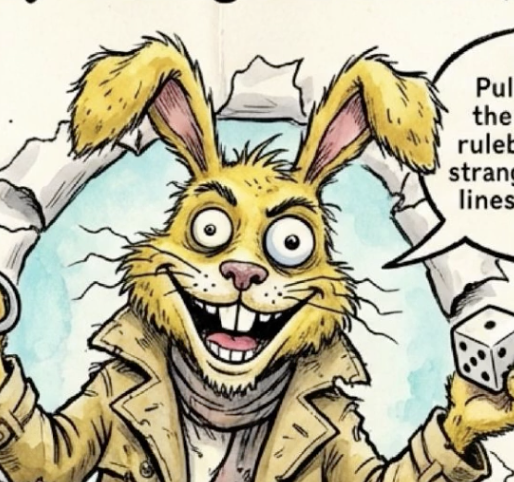
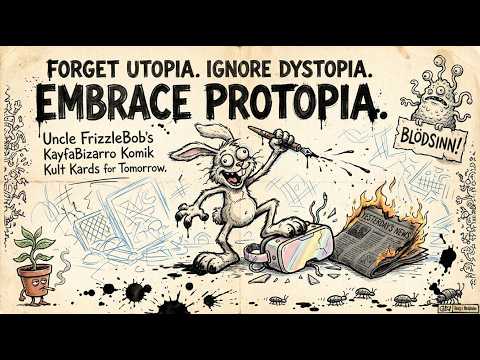
You sit down. You draw a card. You announce who you are — loud, in character, no apologies. Somebody else draws a card and contradicts everything you just said. This is not a problem. This is the game. Cards are not rules. They are invitations. Reality is not fixed — it is negotiated, one sentence at a time, until the story lands or the die hits 6. Put on your mask. Let's wrestle. — Uncle FrizzleBob (Professional Reality-Wrestler & Epistemiologic Outlaw)

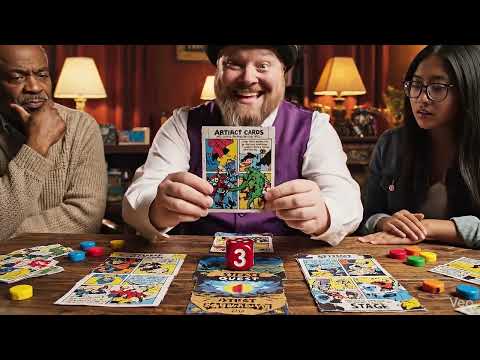
A collaborative storytelling card game where every card is a character you perform. Roll a die for your story mode, introduce a card with a short ritual, tell a story in character, push the Quest Die toward the Finale. No board. No score. No winner. Just a story that didn't exist before you sat down.

Two variants, same bones. Choose your reality:

Get all decks free on Gumroad ↗
Du setzt dich hin. Du ziehst eine Karte. Du verkündest, wer du bist — laut, in character, ohne Entschuldigung. Jemand anderes zieht eine Karte und widerspricht allem, was du gerade gesagt hast. Das ist kein Problem. Das ist das Spiel. Karten sind keine Regeln. Sie sind Einladungen. Realität ist nicht festgelegt — sie wird verhandelt, einen Satz nach dem anderen, bis die Story landet oder der Würfel auf 6 steht. Setz die Maske auf. Lass uns wrestlen. — Onkel FrizzleBob (Professioneller Realitäts-Wrestler & Epistemologischer Outlaw)

Ein kollaboratives Erzählkartenspiel, bei dem jede Karte ein Character ist, den du performst. Würfel für deinen Story-Modus, führe eine Karte mit einem kurzen Ritual ein, erzähl eine Geschichte in character, treib den Quest-Würfel zum Finale. Kein Brett. Kein Score. Kein Gewinner. Nur eine Story, die vor dem Hinsetzen noch nicht existiert hat.

Zwei Varianten. Gleiche Knochen. Wähl deine Realität:

Alle Decks gratis auf Gumroad ↗
"This is not a game you play. It's a game you use. Nobody wins. Nobody loses. Everybody leaves slightly changed. That's the plan. Stay fluffy."— Uncle FrizzleBob
Illustrated Rulebook

Uncle FrizzleBob's illustrated Anti-Rule Book — browse all pages inline.

Click "Next →" to browse the illustrated rulebook.
01 What is this?

You tell a shared story using cards, two dice, and whatever's in your head. One sentence at a time — everyone takes turns introducing a card and building on what came before, until the Quest Die hits 6 and the story lands.

Read through Setup, then start. The rest makes sense as you play.

Kayfabe

Wrestling-speak for "the fiction is real." Your story is the reality. Commit to it.

Bizarro

The permission to be strange and illogical on purpose. Logic is optional. Surprises are mandatory. Don't explain it — perform it.

What you need
Cards — Each player brings 15–20 illustrated cards. Shuffle into one shared deck. Every card can be a Character, Scene, or Quest.
Two D6 — One Story-Mode Die, one Quest Die. Both stay visible at all times.
1–6 People — And a table. No board. No pawns. No manual thicker than your wrist.
02 Setup
1DealGive 3 secret cards to each player. Two minutes total.
2CharactersEach player picks 1 card from their hand, reveals it face-up, and runs the Intro Ritual.
3Quest RevealFluffiest player (you know who) draws a Quest card from the top of the deck and runs the Intro Ritual. Quest Die to 1.
4StageThe Stage starts empty. Three Scene slots, all open.
5GoThey take the first turn.
"New to this? Skip the Story-Mode Die for the first round — everyone just runs the Intro Ritual for their Character. Once everyone's in, roll as normal."
03 The Intro Ritual

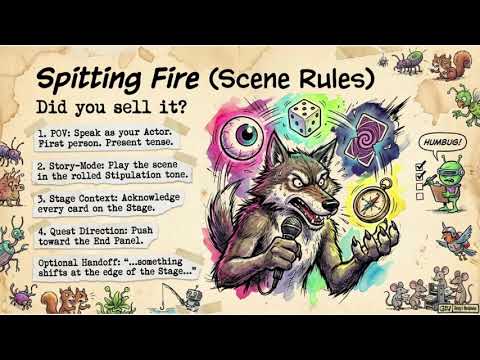
Every card that enters the game must be introduced via the Ritual. Think: wrestling entrance. Three beats. Thirty seconds. In character.

Name ItPoint at the card. Announce its name loud. This is who just entered.
Claim ItOne sentence: what does this card want? Read the LORE or invent from the image.
Power ItDon't explain it. Perform it. Show us what this Power does to reality right now.
Note — The Intro Ritual applies to every card, every time — Quest cards, Scene cards, new Characters. Always.
04 Your Turn

Five steps. Always in this order.

01DrawDraw 1 card from the top of the shared deck. You now hold 4 cards temporarily.
02RollRoll the Story-Mode Die. This is your Mode. Not optional. Commit.
03PlayChoose 1 card and play it as a Scene card onto a Stage slot (empty, or overwrite at 3/3 — see §06) — or as your new Character. Either way: Intro Ritual. You return to 3 hand cards.
04TellIn character, in your Mode. Build on the card, weave in the Stage. The Quest must be felt. Power woven in → card to discard. Power skipped → card stays on the Stage.
05MoveMove the Quest Die: +2, +1, 0, or –1. Your dramaturgical decision.
05 The Six Story Modes

Roll the Story-Mode Die at the start of your turn. Not optional. Commit to it.

1
Tragic
Loss is real. Push forward anyway.
2
Comic
Things go wrong. It's your fault. Play the gap.
3
Absurd
The impossible is normal. Don't explain it.
4
Heroic
Your Character is right for this moment. Play the peak.
5
Mystical
Something's happening beneath the surface.
6
Forbidden
Cross the line the story's been politely avoiding. Sell it.
"The Mode is a frame, not a cage. I didn't invent the rules of drama — I just put them on dice."
06 The Stage

The Stage holds three Scene card slots — the shared reality everyone is playing inside. Each slot starts empty.

Empty slot — Fill it with a Scene card from your hand (Intro Ritual, then play).
Stage full (3/3) — Overwrite an existing slot with a yes-and: choose one card to discard and replace it. Not a yes-but-actually-no.
Character Switch

Instead of playing a Scene card, you can play a new Character card in front of you, replacing your current one, at any time during Step 03. Your old Character leaves the story or becomes an NPC controlled by the table. Change your voice and posture immediately. The Stage is unchanged. Draw back up to 3 hand cards.

"A good death scene is a gift to the story. Accept gifts."
07 The Quest Die

A story compass, not a countdown. Not a timer. You move it.

1–2
Akt I
Setup
3–4
Akt II
Escalation
5
Ordeal
Crisis
6
Finale
It ends.
+2 — Hard push. Use sparingly.
+1 — Normal progression.
0 — Hold. Linger. Build character.
–1 — Step back. When a twist reframes everything.
Note — Quest Die never goes below 1. When it hits 6, the next player's turn is the Finale turn.
08 The Finale

When the Quest Die hits 6, the next player's turn is the Finale turn. Same 5 steps — but the Quest must resolve in the Tell.

Memory — Quest card stays on the table as a shared record of this episode.
Clear — Stage cleared. All Scene cards go to discard.
New Quest — Next player draws a Quest card and runs the full Quest Reveal ritual.
Reset — Quest Die back to 1. New episode begins.
"The Finale doesn't have to be good. It has to be true — true to what everyone built."
Optional Rules
Quest Fail (variant — overrides the floor) — Drop the "never below 1" rule. If the Die falls below 1: Quest fails. No Finale, no memory. The collapse is the story.
Staged Clearing — Roll after Finale. 1–2: remove 1 Scene. 3–4: remove 2. 5–6: all three. Survivors carry history forward.
09 Social Calls

Called after a story — before the next player starts. The Quest Die move stands unless BLÖDSINN! lands.

KayfaBINGO!That landed. Pure praise. Storyteller draws an extra card.
KayfaBOGGLE?I'm lost. One concrete question. Active player answers in 1–2 sentences, in character.
KayfaBONGO!A player narrated their Power as a mechanic ("blocks 70%", "+2 damage"). Anyone calls it. Active player restates the Power as story, not transaction. No die effect.
BLÖDSINN!Rule broken: out of character, Scene forgotten, Mode ignored. Majority decides. If stands: Quest Die does not move.
Table Culture
Kayfab-Finger Rule — Point at every card as you mention it.
Tempo Matters — Fast play = chaotic fun. Slow play = emotional depth. Both are valid.
Silence Is Allowed — 10 seconds to think. Don't rush the Bizarro.
Overacting Is Encouraged — If you're not embarrassed, you're not playing hard enough.
X-Card — Tap the table to stop and reset a scene. No questions asked.
Laughter Breaks Nothing — If everyone's laughing, you're playing it right.
Solo Play — The Lonely Rabbit Mode

Play all Characters yourself, switching perspectives. The Story-Mode Die still applies. Switch seats or hats to track who is who.

"I'm my own best audience anyway."
10 Powers & Cards

Nothing on a card is a rule. Everything on a card is an invitation to perform.

Anatomy of a Card
Image — Makes a claim without words. Your starting point.
Quote — The card's voice. Anchor for your narration.
Lore — Context or backstory. Use it or ignore it.
Power — What this card does in the story. Mandatory when introduced.
How to Use a Power
Don't say
"I play EGO TRIP. The Quest card reverses."
Say instead
"Everything the table thought it was building toward — it's the wrong way up now. The Copernican Shift doesn't argue. It just waits."
Note — If you wove the Power into your story, the Scene card goes to discard. If you ran the Intro Ritual but didn't weave the Power — the Scene card stays in its Stage slot until overwritten. (Characters stay in front of you regardless — they leave only via Character Switch.)
Stacking Powers

Resolve in the order they were played. If they contradict each other, that contradiction is the scene. Play it.

11 Sample Deck

Browse the Protopia deck — free to download.

Click "Next →" to browse the deck.
Download free on Gumroad ↗
12 All Rituals at a Glance
Intro RitualEvery card entering play — Name it · Claim it · Power it · 30 seconds · in character
Quest RevealEpisode start & after every Quest collapse — Intro Ritual → frame the tension → Quest Die to 1 → first story
Character SwitchStep 03 only — Intro Ritual for new Character → brief exit for old → Stage unchanged → draw back to 3 cards
Finale & ResetQuest Die hits 6 — Finale story → Quest card as memory → Stage cleared → Quest Reveal → Die to 1
13 Common Questions
Do I have to mention every Scene card?Yes — at least acknowledge each one on the Stage. A single word is enough.
What if my story doesn't make sense?Good. Coherence is optional. Connection matters more than logic.
Can I lie?Yes. Cards don't enforce truth. They enforce claims.
Can I pass?Yes. Use it sparingly — passing too often kills momentum.
BINGO and BLÖDSINN! at once?All calls are heard. If they clash: BLÖDSINN! takes priority.
Can I add my own cards?Absolutely. Blank cards exist for this reason. Make them strange.
Is there a correct way to play?No. Only the rules that emerge at your table.
14 Quick Reference
Every Turn — 5 Steps
01 DrawDraw 1 card (hand 3 → 4)
02 RollRoll Story-Mode Die — commit to it
03 PlayScene → Stage slot OR Character Switch — always Intro Ritual
04 TellIn character · in Mode · weave in Stage · Power woven in → discard · Power skipped → stays on Stage
05 MoveQuest Die +2 / +1 / 0 / –1 · BLÖDSINN! → no move · At 6: Finale (next turn)
Story Modes
1 — TragicLoss is real. Push forward anyway.
2 — ComicThings go wrong. It's your fault.
3 — AbsurdThe impossible is normal. Don't explain it.
4 — HeroicYour Character is right for this moment.
5 — MysticalSomething's happening beneath the surface.
6 — ForbiddenCross the line. Sell it.
Social Calls
BINGO!That landed. Storyteller draws a card.
BOGGLE?One question, answered in character.
BONGO!Power as mechanic → restate as story.
BLÖDSINN!Rule broken → Quest Die does not move.
"KayfaBizarro is unfinished by design. That part's yours. Cut the cards. Shuffle them. Start playing. Stay fluffy."
— Uncle FrizzleBob
"Das ist kein Spiel, das du spielst. Es ist ein Spiel, das du benutzt. Niemand gewinnt. Niemand verliert. Alle gehen leicht verändert. Das ist der Plan. Bleib flauschig."— Onkel FrizzleBob
Illustriertes Regelbuch

Onkel FrizzleBobs illustriertes Anti-Regelbuch — alle Seiten inline durchblättern.

„Weiter →" klicken um das Regelbuch zu durchblättern.
01 Worum geht's?

Ihr erzählt eine gemeinsame Geschichte mit Karten, zwei Würfeln und allem, was in euren Köpfen ist. Ein Satz nach dem anderen — jeder führt der Reihe nach eine Karte ein und baut auf dem auf, was vorher kam, bis der Quest-Würfel auf 6 steht.

Lest das Setup durch, dann legt los. Der Rest ergibt sich beim Spielen.

Kayfabe

Wrestling-Sprache für "die Fiktion ist echt." Eure Story ist die Realität. Geht voll rein.

Bizarro

Die Erlaubnis, mit Absicht seltsam und unlogisch zu sein. Logik ist optional. Überraschungen sind Pflicht. Erklär es nicht — spiel es.

Was ihr braucht
Karten — Jeder bringt 15–20 illustrierte Karten mit. In einen gemeinsamen Stapel mischen. Jede Karte kann ein Character, eine Scene oder eine Quest sein.
Zwei W6 — Ein Story-Mode-Würfel, ein Quest-Würfel. Beide jederzeit sichtbar.
1–6 Personen — Und einen Tisch. Kein Brett. Keine Pawns. Kein Regelheft dicker als euer Handgelenk.
02 Setup
1AusteilenJedem 3 Karten geheim geben. Zwei Minuten insgesamt.
2CharactereJeder zieht 1 Karte aus seiner Hand, deckt sie offen auf und macht das Intro-Ritual.
3Quest-RevealDie flauschigste Person (du weißt, wer) zieht eine Quest-Karte vom Stapel und macht das Intro-Ritual. Quest-Würfel auf 1.
4BühneDie Bühne startet leer. Drei Scene-Slots, alle offen.
5Los!Sie fängt mit der ersten Runde an.
"Neu hier? In der ersten Runde den Story-Mode-Würfel weglassen — jeder macht nur das Intro-Ritual für seinen Character. Sobald alle drin sind, normal würfeln."
03 Das Intro-Ritual

Jede Karte, die ins Spiel kommt, muss übers Ritual eingeführt werden. Drei Beats. Dreißig Sekunden. In character.

Name ItAuf die Karte zeigen. Den Namen laut verkünden. Das ist, wer gerade reinkommt.
Claim ItEin Satz: was will diese Karte? LORE vorlesen oder aus dem Bild erfinden.
Power ItErklär es nicht. Spiel es. Zeig uns, was diese Power gerade jetzt mit der Realität macht.
Hinweis — Das Intro-Ritual gilt für jede Karte, jedes Mal — Quest-Karten, Scene-Karten, neue Charactere. Immer.
04 Dein Zug

Fünf Schritte. Immer in dieser Reihenfolge.

01ZiehenZieh 1 Karte vom Stapel. Du hältst jetzt kurz 4 Karten in der Hand.
02WürfelnStory-Mode-Würfel werfen. Das ist dein Modus. Nicht optional. Geh rein.
03SpielenEine Karte aussuchen und spielen — als Scene-Karte auf einen Bühnen-Slot (leer, oder überschreiben bei 3/3 — siehe §06) — oder als deinen neuen Character. Egal was: Intro-Ritual. Du gehst zurück auf 3 Handkarten.
04ErzählenIn character, in deinem Modus. Bau auf der Karte auf, web die Bühne ein. Die Quest muss spürbar sein. Power eingewoben → Karte auf den Ablagestapel. Power ausgelassen → Karte bleibt auf der Bühne.
05BewegenQuest-Würfel bewegen: +2, +1, 0, oder –1. Deine dramaturgische Entscheidung.
05 Die sechs Story-Modi

Story-Mode-Würfel zu Beginn deines Zuges werfen. Nicht optional. Geh rein.

1
Tragisch
Verlust ist echt. Trotzdem weiter.
2
Komisch
Es geht schief. Du bist schuld. Spiel die Lücke.
3
Absurd
Das Unmögliche ist normal. Erklär es nicht.
4
Heroisch
Dein Character ist richtig für diesen Moment. Spiel den Höhepunkt.
5
Mystisch
Da passiert was unter der Oberfläche.
6
Verboten
Überschreite die Linie, die die Story höflich gemieden hat. Verkauf es.
"Der Modus ist ein Rahmen, kein Käfig. Ich hab die Regeln des Dramas nicht erfunden — ich hab sie nur auf Würfel gesetzt."
06 Die Bühne

Die Bühne hat drei Scene-Slots — die geteilte Realität, in der alle gerade spielen. Jeder Slot startet leer.

Leerer Slot — Füll ihn mit einer Scene-Karte aus deiner Hand (Intro-Ritual, dann spielen).
Bühne voll (3/3) — Einen vorhandenen Slot per yes-and überschreiben: eine Karte zum Ablegen wählen und ersetzen. Kein yes-but-actually-no.
Character-Wechsel

Statt einer Scene-Karte kannst du jederzeit während Schritt 03 eine neue Character-Karte vor dich legen, deine bisherige ersetzend. Dein alter Character verlässt die Story oder wird zum NPC, geführt vom Tisch. Wechsle Stimme und Haltung sofort. Die Bühne bleibt unverändert. Geh zurück auf 3 Handkarten.

"Eine gute Todesszene ist ein Geschenk an die Story. Geschenke nimmt man an."
07 Der Quest-Würfel

Ein Story-Kompass, kein Countdown. Kein Timer. Du bewegst ihn.

1–2
Akt I
Aufbau
3–4
Akt II
Eskalation
5
Tortur
Krise
6
Finale
Es endet.
+2 — Harter Druck. Sparsam einsetzen.
+1 — Normaler Verlauf.
0 — Halten. Verweilen. Character aufbauen.
–1 — Schritt zurück. Wenn ein Twist alles neu rahmt.
Hinweis — Quest-Würfel fällt nie unter 1. Bei 6: der nächste Zug ist der Finale-Zug.
08 Das Finale

Wenn der Quest-Würfel auf 6 steht, ist der Zug der nächsten Person der Finale-Zug. Dieselben 5 Schritte — aber die Quest muss aufgelöst werden im Erzählen.

Erinnerung — Quest-Karte bleibt am Tisch als geteiltes Protokoll dieser Episode.
Bühne weg — Bühne wird geräumt. Alle Scene-Karten auf den Ablagestapel.
Neue Quest — Nächster Spieler zieht eine Quest-Karte und macht das volle Quest-Reveal-Ritual.
Reset — Quest-Würfel zurück auf 1. Neue Episode startet.
"Das Finale muss nicht gut sein. Es muss wahr sein — wahr zu dem, was alle aufgebaut haben."
Optionale Regeln
Quest Fail (Variante — hebelt den Boden aus) — Die „nie unter 1"-Regel weglassen. Fällt der Würfel unter 1: Quest gescheitert. Kein Finale, keine Erinnerung. Der Zusammenbruch ist die Story.
Staged Clearing — Nach dem Finale würfeln. 1–2: 1 Scene weg. 3–4: 2 weg. 5–6: alle drei. Überlebende tragen die Geschichte weiter.
09 Social Calls

Werden nach einer Story gerufen — bevor die nächste Person dran ist. Die Quest-Würfel-Bewegung gilt, außer BLÖDSINN! landet.

KayfaBINGO!Das hat gesessen. Pures Lob. Erzähler*in zieht eine Extra-Karte.
KayfaBOGGLE?Ich bin raus. Eine konkrete Frage. Aktive Person antwortet in 1–2 Sätzen, in character.
KayfaBONGO!Jemand hat seine Power als Mechanik erzählt ("blockt 70%", "+2 Schaden"). Irgendwer ruft's. Aktive Person formuliert die Power als Story um, nicht als Transaktion. Kein Würfel-Effekt.
BLÖDSINN!Regel gebrochen: aus der Rolle, Scene vergessen, Modus ignoriert. Mehrheit entscheidet. Wenn's steht: Quest-Würfel bewegt sich nicht.
Tisch-Kultur
Kayfab-Finger-Regel — Auf jede Karte zeigen, wenn du sie erwähnst.
Tempo zählt — Schnell = chaotischer Spaß. Langsam = emotionale Tiefe. Beides gültig.
Stille ist erlaubt — 10 Sekunden zum Denken. Nicht das Bizarro hetzen.
Übertreiben ist Pflicht — Wenn dir nicht peinlich ist, spielst du nicht hart genug.
X-Card — Auf den Tisch klopfen, um eine Szene zu stoppen und neu zu setzen. Keine Fragen.
Lachen bricht nichts — Wenn alle lachen, spielt ihr's richtig.
Solo — Lonely Rabbit Mode

Spiel alle Charactere selbst, wechsle Perspektiven. Story-Mode-Würfel gilt weiter. Wechsle Plätze oder Hüte, um zu tracken, wer wer ist.

"Ich bin sowieso mein eigenes bestes Publikum."
10 Powers & Karten

Nichts auf einer Karte ist eine Regel. Alles auf einer Karte ist eine Einladung zur Performance.

Anatomie einer Karte
Bild — Macht eine Behauptung ohne Worte. Dein Startpunkt.
Quote — Die Stimme der Karte. Anker für deine Erzählung.
Lore — Kontext oder Backstory. Nutz sie oder ignorier sie.
Power — Was diese Karte in der Story tut. Pflicht beim Einführen.
Wie man eine Power benutzt
Sag nicht
„Ich spiele EGO TRIP. Die Quest-Karte dreht sich um."
Sag stattdessen
„Alles, worauf der Tisch dachte hinzuarbeiten — es steht jetzt falsch herum. Der Kopernikanische Wandel argumentiert nicht. Er wartet einfach."
Hinweis — Wenn du die Power eingewoben hast, wandert die Scene-Karte auf den Ablagestapel. Wenn du das Intro-Ritual gemacht hast, aber die Power nicht eingewoben hast — die Scene-Karte bleibt in ihrem Bühnen-Slot, bis sie überschrieben wird. (Charactere bleiben vor dir, egal was — sie gehen nur durch Character-Wechsel.)
Powers stapeln

In der Reihenfolge auflösen, in der sie gespielt wurden. Wenn sie sich widersprechen, ist genau dieser Widerspruch die Szene. Spiel ihn.

11 Beispiel-Deck

Das Protopia-Deck durchblättern — gratis zum Download.

„Weiter →" klicken um das Deck zu durchblättern.
Gratis auf Gumroad downloaden ↗
12 Alle Rituale auf einen Blick
Intro-RitualJede Karte beim Eintritt — Name it · Claim it · Power it · 30 Sek · in character
Quest-RevealEpisodenstart & nach jedem Quest-Kollaps — Intro-Ritual → Spannung rahmen → Quest-Würfel auf 1 → erste Story
Character-WechselNur Schritt 03 — Intro-Ritual für neuen Character → kurzer Abgang für alten → Bühne unverändert → zurück auf 3 Karten
Finale & ResetQuest-Würfel auf 6 — Finale-Story → Quest-Karte als Erinnerung → Bühne geräumt → Quest-Reveal → Würfel auf 1
13 Häufige Fragen
Muss ich jede Scene-Karte erwähnen?Ja — wenigstens jede auf der Bühne anerkennen. Ein einzelnes Wort reicht.
Was, wenn meine Story keinen Sinn ergibt?Gut. Kohärenz ist optional. Verbindung zählt mehr als Logik.
Darf ich lügen?Ja. Karten erzwingen keine Wahrheit. Sie erzwingen Behauptungen.
Darf ich passen?Ja. Sparsam einsetzen — zu oft passen tötet das Tempo.
BINGO und BLÖDSINN! gleichzeitig?Alle Calls werden gehört. Bei Konflikt: BLÖDSINN! hat Priorität.
Darf ich eigene Karten dazumachen?Auf jeden Fall. Blanko-Karten gibt's genau dafür. Mach sie seltsam.
Gibt's eine richtige Art zu spielen?Nein. Nur die Regeln, die an eurem Tisch entstehen.
14 Schnellreferenz
Jeder Zug — 5 Schritte
01 ZiehenZieh 1 Karte (Hand 3 → 4)
02 WürfelnStory-Mode-Würfel werfen — geh rein
03 SpielenScene → Bühnen-Slot ODER Character-Wechsel — immer Intro-Ritual
04 ErzählenIn character · im Modus · Bühne einweben · Power eingewoben → Ablage · Power ausgelassen → bleibt auf Bühne
05 BewegenQuest-Würfel +2 / +1 / 0 / –1 · BLÖDSINN! → keine Bewegung · Bei 6: Finale (nächster Zug)
Story-Modi
1 — TragischVerlust ist echt. Trotzdem weiter.
2 — KomischEs geht schief. Du bist schuld.
3 — AbsurdDas Unmögliche ist normal. Erklär es nicht.
4 — HeroischDein Character ist richtig für diesen Moment.
5 — MystischDa passiert was unter der Oberfläche.
6 — VerbotenÜberschreite die Linie. Verkauf es.
Social Calls
BINGO!Hat gesessen. Erzähler*in zieht eine Karte.
BOGGLE?Eine Frage, beantwortet in character.
BONGO!Power als Mechanik → als Story neu formulieren.
BLÖDSINN!Regel gebrochen → Quest-Würfel bewegt sich nicht.
"KayfaBizarro ist mit Absicht unfertig. Der Rest gehört euch. Karten ausschneiden. Mischen. Anfangen zu spielen. Bleib flauschig."
— Onkel FrizzleBob
It's 2am in the ambulance bay. Someone draws Fibby Fitz — Atrial Fibrillation — and rolls a 3. Mechanism Flash. They have to explain why the ventricles only catch every third beat, without looking at the card. They get it half-right. The table fills in the rest. That's not a side effect of the game. That's the point.— Doc FrizzleBob, Professor of Anarcho-Medicine & Reluctant Attending
Illustrated Rulebook

Doc FrizzleBob's illustrated clinical rulebook — browse all pages inline.

Click "Next →" to browse the illustrated rulebook.
01 What is this?

You each play a Character — a clinician, a drug, an immune cell, a rogue signalling molecule, or a personified disease. Together you build a shared Clinical Stage and push a Medical Quest toward resolution.

When the Quest Die hits 6, someone delivers the Finale: the diagnosis, the mechanism, the treatment decision. No win condition. No score.

What you need
Cards — From any MedKayfab deck — Cardiology, Neurology, Immunology, Pharmacology. Mix freely.
Two D6 — One Story-Mode Die, one Quest Die. Both visible at all times.
Optional — A blank card or notebook for the Mechanism Log.
02 Setup
1DealGive 3 cards to each player. Keep them secret. Scrub in — two minutes.
2CharactersEveryone picks 1 card from their hand, reveals it face-up, and runs the Intro Ritual — in character, out loud.
3Quest RevealMost caffeinated player (you know who) draws a Quest card, runs the Intro Ritual, frames the clinical tension. Quest Die to 1.
4StageThe Stage starts empty. Three Scene slots, all open.
5GoThey take the first turn.
"You will feel slightly ridiculous for the first few minutes. That's fine. The ridiculous is where the mechanism is memorable."
03 The Intro Ritual
Name ItAnnounce the card's name and the clinical concept. Loud.
Claim ItOne sentence: what is its mechanism? Read the LORE or invent from the image.
Power ItDon't explain it. Perform it. Show us what this Power does to the patient right now.
Note — The Intro Ritual applies to every card, every time. Always.
04 Your Turn
01DrawDraw 1 card (temporarily 4 hand cards).
02RollRoll the Story-Mode Die. This is your Clinical Mode. Commit to it.
03PlayScene card onto a Stage slot (empty, or overwrite at 3/3 — see §06) — or new Character. Always: Intro Ritual. Return to 3 hand cards.
04TellIn character, in your Mode. Weave in the Stage. The Quest must be felt. Power woven in → Scene card to discard. Power skipped → card stays on the Stage.
05MoveQuest Die: +2, +1, 0, or –1. Never below 1.
05 The Six Clinical Modes
1
Lab Report
Dry. Factual. Sound like a pharma rep — and critique it while you do.
2
Clin. Sabotage
Something goes wrong. A diagnostic error, a drug interaction. Mechanism under pressure.
3
Mech. Flash
Active Recall. Explain the LORE without looking. Table majority decides if you got it; ties go to you. If yes: Quest Die +1. Then read the LORE aloud — no penalty for gaps.
4
Power-Play
Drug hits receptor. Pathogen evades. Perform the mechanism.
5
Teaching Round
Another player asks one question. Answer in character. No shaming.
6
Prof. Blessing
Total anarchy. Play a card directly to the Stage and move the Quest Die as you see fit.
"Mode 5 is 'The Teaching Round' — not 'Pimping.' We ask because we're curious. We answer because we're trying."
06 The Clinical Stage

Three Scene card slots — the shared clinical reality. All slots start empty.

Empty slot — Fill it with a Scene card (Intro Ritual, then play).
Stage full (3/3) — Overwrite a slot with a yes-and.
Character Switch

Instead of playing a Scene card, you can play a new Character card in front of you, replacing your current one, at any time during Step 03. Your old Character exits the case or becomes an NPC. The Stage is unchanged. Draw back up to 3 hand cards.

07 The Quest Die

Tracks the progression of the clinical case. A story compass, not a countdown.

1–2
Anamnesis
Symptoms
3–4
Workup
Escalation
5
Crisis
Must give
6
Finale
Case closes.
Note — Quest Die never goes below 1. When it hits 6, the next player's turn is the Finale turn.
Quest Formats
Standard Quest — Any card. Starting player frames the clinical tension.
Prepared Quests — Write clinical scenarios on blank cards.
Mechanism Quests — A mechanism to reconstruct collectively.
08 The Grand Finale

When the Quest Die hits 6, the next player's turn is the Finale turn. Same 5 steps — but the Quest must resolve in the Tell.

Memory — Quest card stays on table. Write the mechanism on it if running the Mechanism Log.
Tabula Rasa — Stage clears. All Scene cards to discard.
New Quest — Next player runs Quest Reveal. Quest Die to 1.
"A messy ending that was earned beats a clean answer that was imported from the index."
Optional Rules
Quest Fail (variant — overrides the floor) — Drop the "never below 1" rule. If the Die falls below 1: Quest fails. No Finale, no mechanism logged. The collapse is the case.
Staged Clearing — Roll after Finale. 1–2: remove 1 Scene. 3–4: remove 2. 5–6: all three. Survivors carry case history forward.
09 Social Calls
KayfaBINGO!The mechanism clicked. Spontaneous — no explanation needed.
KayfaBOGGLE?One concrete question — not a judgment, a gap. Answered in 1–2 sentences.
KayfaBONGO!A player narrated a Power as a stat ("blocks COX-1 by 70%", "−2 damage"). Anyone calls it. Active player restates the Power as story beat. No die effect.
BLÖDSINN!Rule broken. Majority decides. If stands: Quest Die does not move.
Solo Play — Study Session Mode

Draw 5 cards. Pick one as Character. Draw or write a Quest. Stage empty. Quest Die to 1. Play all Characters yourself. After each story: write one sentence in the Mechanism Log.

"Solo MedKayfab is essentially the Feynman Technique with cards and a die. The cards make the gaps visible."
10 Powers & Cards

Nothing on a card is a rule. Powers are narrative invitations — not mechanics, not modifiers.

Don't say
"I block COX-1 and reduce thromboxane by 70%."
Say instead
"Every platelet in the bloodstream goes suddenly, permanently quiet. The surgical team will notice this tomorrow. The patient's wife is on warfarin. Nobody checked."
Note — If you wove the Power into your story, the Scene card goes to discard. If you ran the Intro Ritual but didn't weave the Power — the Scene card stays in its Stage slot until overwritten. (Characters stay in front of you regardless — they leave only via Character Switch.)
The Mechanism Log

After each Quest Finale, one player writes — in one sentence — the core mechanism that emerged. At the end of a session, read the Log aloud.

11 Learning Add-Ons
Add-On A — Anki Mode
After each Finale: Front = character name + clinical clue. Back = core mechanism in one sentence. Add to Anki. Review tomorrow.
Add-On B — Feynman Round
Once per Quest, one player explains a Stage card's mechanism — no jargon, one minute max. Group understands it: Quest Die +1 immediately.
Add-On C — Spaced Repetition
Shuffle in 3–5 marked cards from previous sessions. When one appears: explain from memory before the Intro Ritual. Success: +1 Quest Die.
Add-On D — Peer Teaching Round
After each Finale, roll D6 — highest = teacher. 3 minutes, one card, mechanism + clinical relevance. Group asks one question each.
12 Sample Deck
Click "Next →" to browse the deck.
Download free on Gumroad ↗
13 All Rituals at a Glance
Intro RitualEvery card entering play — Name it · Claim it · Power it · 30 seconds · in character
Quest RevealEpisode start & after every collapse — Intro Ritual → frame clinical tension → Quest Die to 1 → first story
Character SwitchStep 03 only — Intro Ritual for new Character → brief exit for old → Stage unchanged → draw back to 3 cards
Finale & ResetQuest Die hits 6 — Finale story → mechanism logged → Stage cleared → Quest Reveal → Die to 1
14 Common Questions
Story not clinically accurate?Plausible is better than perfect. The act of trying to make it plausible is the learning.
Can I invent mechanisms?Yes. If wrong, KayfaBOGGLE will surface it. That's the point.
Can I mix decks?Absolutely. The human body doesn't respect specialty boundaries.
Can I add my own cards?Yes. Write characters from your own cases. Make them specific. Make them strange.
15 Quick Reference
Clinical Story Modes
1 — Lab ReportDry. Factual. Critique the brochure.
2 — Clin. SabotageSomething breaks. Mechanism under pressure.
3 — Mech. FlashActive recall. Table decides. +1 Quest Die if you got it.
4 — Power-PlayMolecule attacks. Perform the mechanism.
5 — Teaching RoundOne question. Answer in character. No shaming.
6 — Prof. BlessingTotal anarchy. Play to Stage + move Quest Die freely.
Quest Die — Clinical Arc
1–2Anamnesis — symptoms, characters introduced
3–4Workup — investigations, escalation
5Crisis Point — differential narrows
6Grand Finale — mechanism named, case resolved (next turn)
"MedKayfab is unfinished by design. That part's yours. Cut the cards. Scrub in."
— Doc FrizzleBob
Es ist 2 Uhr morgens im Aufnahmebereich. Jemand zieht Fibby Fitz — Vorhofflimmern — und würfelt eine 3. Mech. Flash. Sie müssen erklären, warum die Ventrikel nur jeden dritten Schlag erwischen, ohne auf die Karte zu schauen. Sie liegen halb richtig. Der Tisch ergänzt den Rest. Das ist kein Nebeneffekt des Spiels. Das ist der Punkt.— Doc FrizzleBob, Professor für Anarcho-Medizin & Widerwilliger Attending
Illustriertes Regelbuch

Doc FrizzleBobs illustriertes klinisches Regelbuch — alle Seiten inline durchblättern.

„Weiter →" klicken um das Regelbuch zu durchblättern.
01 Worum geht's?

Ihr spielt jeweils einen Character — eine Klinikerin, ein Medikament, eine Immunzelle, ein abtrünniges Signalmolekül oder eine personifizierte Erkrankung. Gemeinsam baut ihr eine geteilte Klinische Bühne und treibt eine Medizinische Quest zur Auflösung.

Wenn der Quest-Würfel auf 6 steht, liefert jemand das Finale: die Diagnose, den Mechanismus, die Therapieentscheidung. Keine Win-Condition. Kein Score.

Was ihr braucht
Karten — Aus jedem MedKayfab-Deck — Kardiologie, Neurologie, Immunologie, Pharmakologie. Frei mischen.
Zwei W6 — Ein Story-Mode-Würfel, ein Quest-Würfel. Beide jederzeit sichtbar.
Optional — Eine Blanko-Karte oder ein Notizbuch für das Mechanismus-Log.
02 Setup
1AusteilenJedem 3 Karten geben. Geheim halten. Anziehen — zwei Minuten.
2CharactereJeder zieht 1 Karte aus seiner Hand, deckt sie offen auf und macht das Intro-Ritual — in character, laut.
3Quest-RevealDie koffeinhaltigste Person (du weißt, wer) zieht eine Quest-Karte, macht das Intro-Ritual, rahmt die klinische Spannung. Quest-Würfel auf 1.
4BühneDie Bühne startet leer. Drei Scene-Slots, alle offen.
5Los!Sie fängt mit der ersten Runde an.
"Die ersten paar Minuten wirst du dich leicht lächerlich fühlen. Das ist okay. Im Lächerlichen sitzt der Mechanismus, der hängenbleibt."
03 Das Intro-Ritual
Name ItDen Namen und das klinische Konzept verkünden. Laut.
Claim ItEin Satz: was ist ihr Mechanismus? LORE vorlesen oder aus dem Bild erfinden.
Power ItErklär es nicht. Spiel es. Zeig uns, was diese Power gerade jetzt mit dem Patienten macht.
Hinweis — Das Intro-Ritual gilt für jede Karte, jedes Mal. Immer.
04 Dein Zug
01ZiehenZieh 1 Karte (kurz 4 Handkarten).
02WürfelnStory-Mode-Würfel werfen. Das ist dein klinischer Modus. Geh rein.
03SpielenScene-Karte auf einen Bühnen-Slot (leer, oder überschreiben bei 3/3 — siehe §06) — oder neuer Character. Immer: Intro-Ritual. Zurück auf 3 Handkarten.
04ErzählenIn character, in deinem Modus. Web die Bühne ein. Die Quest muss spürbar sein. Power eingewoben → Scene-Karte auf den Ablagestapel. Power ausgelassen → Karte bleibt auf der Bühne.
05BewegenQuest-Würfel: +2, +1, 0, oder –1. Nie unter 1.
05 Die sechs klinischen Modi

Story-Mode-Würfel werfen. Nicht optional. Geh rein.

1
Laborbericht
Trocken. Sachlich. Nenn die Zahlen. Klinge wie ein Pharma-Vertreter — und kritisier es dabei.
2
Klin. Sabotage
Es geht was schief. Ein Diagnosefehler, eine Wechselwirkung. Mechanismus unter Druck.
3
Mech. Flash
Active Recall. Die LORE erklären, ohne nachzusehen. Tisch-Mehrheit entscheidet; Gleichstand zählt für dich. Wenn ja: Quest-Würfel +1. Dann LORE laut vorlesen — keine Strafe für Lücken.
4
Power-Play
Wirkstoff trifft Rezeptor. Erreger entkommt. Spiel den Mechanismus.
5
Lehrvisite
Eine andere Person stellt eine Frage. Antworte in character. Kein Bloßstellen.
6
Prof.-Segen
Totale Anarchie. Spiel eine Karte direkt auf die Bühne und beweg den Quest-Würfel, wie du willst.
"Modus 5 ist 'Die Lehrvisite' — nicht 'Abfragen'. Wir fragen, weil wir neugierig sind. Wir antworten, weil wir's versuchen."
06 Die klinische Bühne

Drei Scene-Slots — die geteilte klinische Realität: der aktuelle Patientenzustand, die aktive Pathologie, die laufende Therapie. Alle Slots starten leer.

Leerer Slot — Füll ihn mit einer Scene-Karte (Intro-Ritual, dann spielen).
Bühne voll (3/3) — Einen Slot per yes-and überschreiben.
Character-Wechsel

Statt einer Scene-Karte kannst du jederzeit während Schritt 03 eine neue Character-Karte vor dich legen, deine bisherige ersetzend. Dein alter Character verlässt den Fall oder wird zum NPC. Die Bühne bleibt unverändert. Geh zurück auf 3 Handkarten.

07 Der Quest-Würfel

Tracked den Verlauf des klinischen Falls. Ein Story-Kompass, kein Countdown.

1–2
Anamnese
Symptome
3–4
Diagnostik
Eskalation
5
Krise
Diff. eng
6
Finale
Fall geschlossen.
Hinweis — Quest-Würfel fällt nie unter 1. Bei 6: der nächste Zug ist der Finale-Zug.
Quest-Formate
Standard-Quest — Beliebige Karte. Startspieler*in rahmt die klinische Spannung.
Vorbereitete Quests — Klinische Szenarien auf Blanko-Karten schreiben.
Mechanismus-Quests — Ein Mechanismus, der gemeinsam rekonstruiert wird.
08 Das große Finale

Wenn der Quest-Würfel auf 6 steht, ist der Zug der nächsten Person der Finale-Zug. Dieselben 5 Schritte — aber die Quest muss aufgelöst werden im Erzählen.

Erinnerung — Quest-Karte bleibt am Tisch. Mechanismus drauf schreiben, falls ihr das Mechanismus-Log führt.
Tabula Rasa — Bühne wird geräumt. Alle Scene-Karten auf den Ablagestapel.
Neue Quest — Nächste Person macht Quest-Reveal. Quest-Würfel auf 1.
"Ein chaotisches Ende, das verdient wurde, schlägt eine saubere Antwort, die aus dem Index importiert wurde."
Optionale Regeln
Quest Fail (Variante — hebelt den Boden aus) — Die „nie unter 1"-Regel weglassen. Fällt der Würfel unter 1: Quest gescheitert. Kein Finale, kein Mechanismus geloggt. Der Zusammenbruch ist der Fall.
Staged Clearing — Nach dem Finale würfeln. 1–2: 1 Scene weg. 3–4: 2 weg. 5–6: alle drei. Überlebende tragen die Fallgeschichte weiter.
09 Social Calls
KayfaBINGO!Der Mechanismus hat klick gemacht. Spontan — keine Erklärung nötig.
KayfaBOGGLE?Eine konkrete Frage — kein Urteil, eine Lücke. Beantwortet in 1–2 Sätzen.
KayfaBONGO!Jemand hat eine Power als Stat erzählt ("blockt COX-1 zu 70%", "−2 Schaden"). Irgendwer ruft's. Aktive Person formuliert die Power als Story-Beat um. Kein Würfel-Effekt.
BLÖDSINN!Regel gebrochen. Mehrheit entscheidet. Wenn's steht: Quest-Würfel bewegt sich nicht.
Solo — Study Session Mode

5 Karten ziehen. Eine als Character wählen. Quest ziehen oder schreiben. Bühne leer. Quest-Würfel auf 1. Spiel alle Charactere selbst. Nach jeder Story: ein Satz ins Mechanismus-Log.

"Solo-MedKayfab ist im Grunde die Feynman-Technik mit Karten und einem Würfel. Die Karten machen die Lücken sichtbar."
10 Powers & Karten

Nichts auf einer Karte ist eine Regel. Powers sind narrative Einladungen — keine Mechanik, keine Modifier.

Sag nicht
„Ich blockiere COX-1 und reduziere Thromboxan um 70%."
Sag stattdessen
„Jedes Plättchen im Blutkreislauf wird plötzlich, dauerhaft still. Das OP-Team wird's morgen merken. Die Frau des Patienten nimmt Warfarin. Niemand hat nachgesehen."
Hinweis — Wenn du die Power eingewoben hast, wandert die Scene-Karte auf den Ablagestapel. Wenn du das Intro-Ritual gemacht hast, aber die Power nicht eingewoben hast — die Scene-Karte bleibt in ihrem Bühnen-Slot, bis sie überschrieben wird. (Charactere bleiben vor dir, egal was — sie gehen nur durch Character-Wechsel.)
Das Mechanismus-Log

Nach jedem Quest-Finale schreibt eine Person — in einem Satz — den Kernmechanismus auf, der entstanden ist. Am Ende der Session: das Log laut vorlesen.

11 Lern-Add-Ons
Add-On A — Anki Mode
Nach jedem Finale: Front = Charactername + klinischer Hinweis. Back = Kernmechanismus in einem Satz. Zu Anki hinzufügen. Morgen wiederholen.
Add-On B — Feynman-Round
Einmal pro Quest erklärt eine Person den Mechanismus einer Bühnen-Karte — keine Fachsprache, max. eine Minute. Gruppe versteht's: Quest-Würfel +1 sofort.
Add-On C — Spaced Repetition
3–5 markierte Karten aus früheren Sessions einmischen. Wenn eine auftaucht: aus dem Gedächtnis erklären vor dem Intro-Ritual. Erfolg: Quest-Würfel +1.
Add-On D — Peer Teaching Round
Nach jedem Finale W6 würfeln — höchste lehrt. 3 Minuten, eine Karte, Mechanismus + klinische Relevanz. Gruppe stellt je eine Frage.
12 Beispiel-Deck
„Weiter →" klicken um das Deck zu durchblättern.
Gratis auf Gumroad downloaden ↗
13 Alle Rituale auf einen Blick
Intro-RitualJede Karte beim Eintritt — Name it · Claim it · Power it · 30 Sek · in character
Quest-RevealEpisodenstart & nach jedem Kollaps — Intro-Ritual → klinische Spannung rahmen → Quest-Würfel auf 1 → erste Story
Character-WechselNur Schritt 03 — Intro-Ritual für neuen Character → kurzer Abgang für alten → Bühne unverändert → zurück auf 3 Karten
Finale & ResetQuest-Würfel auf 6 — Finale-Story → Mechanismus geloggt → Bühne geräumt → Quest-Reveal → Würfel auf 1
14 Häufige Fragen
Story klinisch nicht korrekt?Plausibel ist besser als perfekt. Der Akt, es plausibel zu machen, ist das Lernen.
Darf ich Mechanismen erfinden?Ja. Wenn falsch, bringt KayfaBOGGLE es ans Licht. Das ist der Punkt.
Darf ich Decks mischen?Auf jeden Fall. Der menschliche Körper respektiert keine Fachgrenzen.
Darf ich eigene Karten dazumachen?Ja. Schreib Charactere aus deinen eigenen Fällen. Mach sie spezifisch. Mach sie seltsam.
15 Schnellreferenz
Klinische Story-Modi
1 — LaborberichtTrocken. Sachlich. Broschüre kritisieren.
2 — Klin. SabotageWas bricht. Mechanismus unter Druck.
3 — Mech. FlashActive Recall. Tisch entscheidet. +1 Quest-Würfel, wenn du's hattest.
4 — Power-PlayMolekül greift an. Spiel den Mechanismus.
5 — LehrvisiteEine Frage. Antwort in character. Kein Bloßstellen.
6 — Prof.-SegenTotale Anarchie. Auf Bühne spielen + Quest-Würfel frei bewegen.
Quest-Würfel — Klinischer Bogen
1–2Anamnese — Symptome, Charactere eingeführt
3–4Diagnostik — Untersuchungen, Eskalation
5Krisenpunkt — Differential schließt
6Großes Finale — Mechanismus benannt, Fall gelöst (nächster Zug)
"MedKayfab ist mit Absicht unfertig. Der Rest gehört euch. Karten ausschneiden. Hände waschen."
— Doc FrizzleBob
KayfaBizarro v19.0 / MedKayfab v19.0 · Georg von Westphalen CC BY-NC-SA 4.0 · Pay What You Want · Do Not Resell
🇬🇧 English
🇩🇪 Deutsch