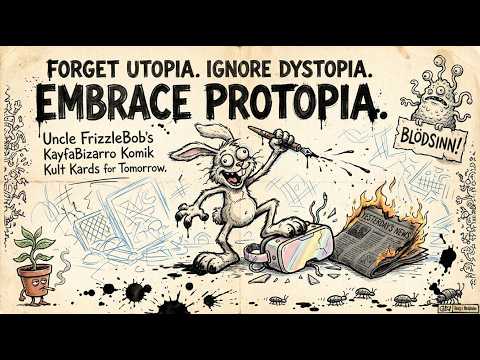
KayfaBizarro
🇬🇧 English
🇩🇪 Deutsch
Welcome to Uncle FrizzleBob's Komik Kard Kult

KayfaBizarroSocial Story-Wrestling

Cut & Play Comics. Not a game you play. A game you use.

Uncle FrizzleBob

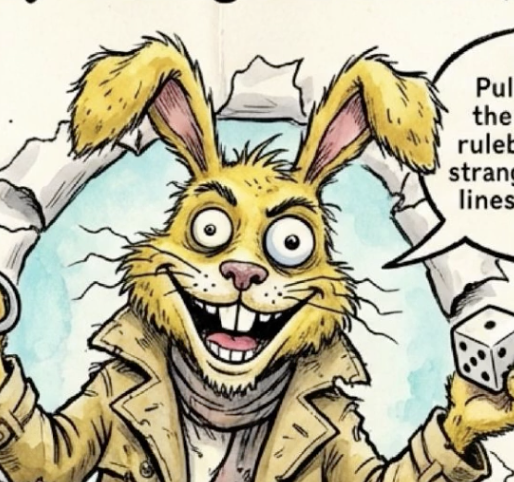
Uncle FrizzleBob here. You're about to download a weird comic. Read it. Print it. Cut it up. Shuffle the cards and play them with one to six fluffy accomplices.

You choose: Three doors to KayfaBizarro.
You need: Two ordinary dice.
You play: Cut-up stories in the gutter.
You get: No exit.

Cognitive dissonance as a social resonance space. Play the truth your way - with plausible deniability.

1-6 players 20-60 min Cut & Play Pay What You Want CC BY-NC-SA 4.0
Free Cut & Play Comics
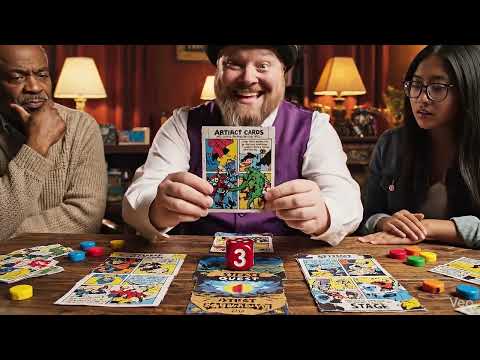
KayfaBizarro session
Watch a session
Cut & Play Comic · Story-Wrestling Edition
KayfaBizarro Freestyle

You move one die. It shows you how close the story is to breaking. Six modes from Tragic to Forbidden — the die rolls, you commit. Cards enter the Stage through Show it. Spin it. Sell it. When someone calls BLÖDSINN!, the room stops and you all decide. Nobody leaves having lost. Everyone leaves slightly different. Including the things said that couldn't have been said over dinner.

Best for: families tired of polite games, therapists who hate worksheets, writers stuck in their own voice. 1-6 humans.

Read the Free Style Rules
Cut & Play Comic · Clinical Edition
MedKayfab Medicine

Same loop, applied to pathophysiology. Your Character is a disease, a drug, a failing organ. The die rolls a 3 - Mechanism Flash. You explain how it actually works from memory while the others heckle. Someone at the table calls BLÖDSINN! — and everyone turns on you immediately. Wrong tonight, right tomorrow, teachable by breakfast.

Best for: med students who've outgrown flashcards, residents on night shift, attendings who teach by humiliation and want to stop. Solo or 1-6 humans.

Read the MedKayfab Rules
How it works

Print it. Cut it. Play the future.

You need: a few friends, scissors, two dice, snacks. That's it. Print the comic and cut the pages into cards together — busy hands, easy talk. (Pro move: glue them onto cardboard, ideally stolen from work — the deck survives high-octane stories and wild party nights.) Shuffle into one pile, then take turns: a character, a rolled mood, a line of story out loud. Somewhere around minute ten everyone forgets to be polite — and that's when it gets good.

1. Download & print
Grab a deck, pay what you want.
2. Cut & shuffle
Scissors turn the page into a deck of cards.
3. Play & pass it on
One to six friends, twenty minutes, one shared comic.

You don't just play cards or tell boring stories.
You suplex consensus reality till it taps out.

Best played with people who do not quite agree with you. So bring a few, bring scissors, and pass it on. The rabbit will handle the rest.

Share the Kult
Willkommen in Onkel FrizzleBobs Komik Kard Kult

KayfaBizarroSocial Story-Wrestling

Cut & Play Comics. Kein Spiel zum Spielen. Ein Spiel zum Benutzen.

Onkel FrizzleBob

Onkel FrizzleBob hier. Du lädst gleich einen seltsamen Comic runter. Lies ihn. Druck ihn aus. Zerschneid ihn. Misch die Karten und spiel sie mit einem bis sechs flauschigen Komplizen.

Du wählst: Drei Türen zu KayfaBizarro.
Du brauchst: Zwei stinknormale Würfel.
Du spielst: Cut-up-Geschichten im Gutter.
Du kriegst: Kein Ausgang.

Kognitive Dissonanz als sozialer Resonanzraum. Spiel die Wahrheit nach deinen Regeln - mit glaubhafter Abstreitbarkeit.

1-6 Spieler 20-60 Min Cut & Play Pay What You Want CC BY-NC-SA 4.0
Gratis Cut & Play Comics
KayfaBizarro Session
Eine Runde ansehen
Cut & Play Comic · Story-Wrestling Edition
KayfaBizarro Freestyle

Du bewegst einen Würfel. Er zeigt dir, wie nah die Geschichte am Reißen ist. Sechs Modi von Tragisch bis Verboten — gewürfelt, committed. Karten kommen über die Bühne per Show it. Spin it. Sell it. Wer BLÖDSINN! ruft, hält das Spiel an — und ihr entscheidet gemeinsam. Niemand verliert. Alle gehen leicht verändert. Einschließlich der Dinge, die beim Abendessen nicht hingekriegt worden wären.

Geeignet für: Familien, die mit höflichen Spielen durch sind, Therapeut*innen mit Allergie gegen Arbeitsblätter, Autor*innen die in ihrer eigenen Stimme festsitzen. 1-6 Menschen am Tisch.

Lies die Free-Style-Regeln
Cut & Play Comic · Klinische Edition
MedKayfab Medicine

Derselbe Loop, angelegt an die Pathophysiologie. Dein Character ist eine Krankheit, ein Medikament, ein versagendes Organ. Der Würfel zeigt 3 - Mechanism Flash. Du erklärst aus dem Gedächtnis, wie es wirklich funktioniert, während die anderen dazwischenrufen. Jemand am Tisch ruft BLÖDSINN! — und alle drehen sich gegen dich. Heute Abend halb falsch, morgen Mittag richtig, beim Frühstück lehrbar.

Geeignet für: Medizinstudierende, die Karteikarten überlebt haben, Assistenzärzt*innen im Nachtdienst, Oberärzt*innen die durch Bloßstellen unterrichten und damit aufhören wollen. Solo oder 1-6 Menschen am Tisch.

Lies die MedKayfab-Regeln
So geht's

Ausdrucken. Zerschneiden. Zukunft spielen.

Du brauchst: ein paar Freunde, eine Schere, zwei Würfel, Snacks. Mehr nicht. Druck den Comic und schneidet die Seiten gemeinsam in Karten — beschäftigte Hände, lockeres Reden. (Pro-Move: kleb sie auf Pappe, am besten aus dem Büro geklaut — so übersteht das Deck High-Octane-Stories und wilde Partynächte.) Misch alles zu einem Stapel, dann reihum: eine Figur, ein gewürfelter Modus, eine Zeile Story laut. Irgendwann um Minute zehn vergisst jede:r, höflich zu sein — und dann wird's gut.

1. Herunterladen & drucken
Deck schnappen, zahl was du willst.
2. Schneiden & mischen
Die Schere macht aus der Seite ein Kartendeck.
3. Spielen & weitergeben
Eine bis sechs Personen, zwanzig Minuten, ein gemeinsamer Comic.

You don't just play cards or tell boring stories.
You suplex consensus reality till it taps out.

Am besten mit Leuten, die nicht ganz deiner Meinung sind. Also bring ein paar mit, bring eine Schere, und gib es weiter. Den Rest macht der Hase.

Teilt den Kult
Social Story-Wrestling

Welcome to the Game

Not a game you play. A game you use.

You cut a comic into a deck. Good. That was the hard part, and it was also the first move. The game already started; nobody told you. Here's the rest.

It's one story you build together, out loud, a card at a time. One to six of you, twenty minutes, no board, nobody wins. Each turn you roll a mood, throw a card into the ring, and sell whatever it is like it's the realest thing in the room. The others buy it, or they yell BLÖDSINN! and the whole thing lurches somewhere nobody planned. That lurch is the good part.

Nobody owns the truth here. There's a referee, King Kayfabian, but the crown moves every turn, and it only steps in when you genuinely can't agree. The rest is you, two dice, and the nerve to commit. If a story lands, it lands. If it face-plants, we all saw it, and that's a story too.

Here's the trick nobody warns you about: because everyone agreed out loud that this is staged, you can finally mean it. Put a card down, let the card take the risk, say the weird, tender, true thing, and blame the rabbit. Five people walk in with five different worlds; for one evening you build a single one and carry it home.

Nobody wins. Nobody loses. Everyone goes home a little rearranged.

Roll a mood. Sell a lie. Keep the story. Stay fluffy.

Rules? → KayfaBizarro or MedKayfab. All free, all optional, like everything I do. — Uncle FrizzleBob

Social Story-Wrestling

Willkommen im Spiel

Kein Spiel, das man spielt. Ein Spiel, das man benutzt.

Du hast einen Comic in ein Deck zerschnitten. Gut. Das war der schwere Teil, und zugleich der erste Zug. Das Spiel hat längst angefangen, dir hat's nur keiner gesagt. Hier ist der Rest.

Ihr baut eine Geschichte zusammen, laut, Karte für Karte. Ein bis sechs Leute, zwanzig Minuten, kein Brett, keiner gewinnt. Reihum würfelst du eine Stimmung, wirfst eine Karte in den Ring und verkaufst sie, als wär sie das Realste im Raum. Die anderen kaufen's dir ab, oder sie rufen BLÖDSINN! und das Ganze kippt irgendwohin, wo keiner hinwollte. Dieses Kippen ist der gute Teil.

Niemandem gehört hier die Wahrheit. Es gibt einen Schiedsrichter, King Kayfabian, aber die Krone wandert jeden Zug weiter und greift nur ein, wenn ihr euch echt nicht einig werdet. Der Rest bist du, zwei Würfel und der Mut, dich festzulegen. Läuft eine Geschichte, läuft sie. Fällt sie auf die Nase, haben's alle gesehen, und das ist auch eine Geschichte.

Und hier der Trick, vor dem dich keiner warnt: weil alle laut zugestimmt haben, dass das hier gestellt ist, kannst du es endlich ernst meinen. Leg eine Karte hin, lass die Karte das Risiko tragen, sag das schräge, zärtliche, wahre Ding, und schieb's auf den Hasen. Fünf Leute kommen mit fünf verschiedenen Welten rein; für einen Abend baut ihr eine gemeinsame und nehmt sie mit nach Hause.

Keiner gewinnt. Keiner verliert. Alle gehen ein bisschen umgebaut nach Hause.

Würfel eine Stimmung. Verkauf eine Lüge. Behalt die Geschichte. Stay fluffy.

Regeln? → KayfaBizarro oder MedKayfab. Alles gratis, alles freiwillig, wie alles, was ich mache. — Onkel FrizzleBob

The Backstory

FrizzleBob's Fractal Almanac

Dispatches from the Infinite Canvas.

I am Uncle FrizzleBob. Rogue cartoon rabbit. Worldview fixer. No refunds, no guarantees, no license anybody signed. What you are holding is not a product, it is a bundle of time capsules, and I collect those. Every card, song and half-finished rule in here is a moment where the official story slipped a gear and something truer fell out of the gap. I keep those in my Fractal Almanac so they cannot pretend they never happened. People kept asking what this is. Here is the closest answer that will not ruin it.

I · The Name Is a Warning Label

Two words, and people get both wrong.

Kayfabe is wrestling's oldest deal. Everyone in the building knows the match is booked, and the crowd loses its mind anyway. Not because they are marks. Because agreeing out loud to treat the staged as real is the most fun a room full of strangers can have with the lights on.

Bizarro is not the chalk-faced fellow from the Superman comics. Wrong universe, put him back. Bizarro is a genre, the pulp and weird-fiction tradition where the world is absurd on purpose and keeps a straight face about it. You already live there. Somebody promised you the future and then rescheduled it for SOON. The news is a documentary that cast you as a focus group. Adam Curtis has a name for the mood, HyperNormalisation: everyone can feel the show is fake, nobody can picture the alternative, so we all keep clapping on the beat.

KayfaBizarro is what happens when you stop flinching at that and start playing it on purpose. Kayfabe, so the table agrees out loud on what is real for the next ten minutes. Bizarro, because the raw material is the whole absurd buffet. The verb is Kayfabulation, kayfabe plus confabulation, the shared reality a table builds together and gets to keep. Most people spend a lifetime inside somebody else's kayfabe and never get a vote. At this table you hold the booking pen.

II · Backstage, Where the Booking Happens

Out front, the official Kayfabe, the show they sell you straight-faced on the hour. Truman never found the edge of his set. Most people never go looking.

I go backstage. There are two ways to read what happens back there, and the whole craft is holding both without blinking.

The first is POSIWID: the purpose of a system is what it does. Stafford Beer's line, the sharpest tool in the drawer. Never mind the mission statement. Watch what the thing produces, year after year, then ask the only honest question. Cui bono. Who books the match, and who walks out still wearing the belt.

The second I call Hanlon's Law of Bizarro-Blödsinn: never attribute to malice what is adequately explained by Blödsinn. Sometimes there is no mastermind in the VIP box. Sometimes it is pure Idiocracy back there, nobody's hand on the wheel, everybody improvising and calling it a plan.

The comedy, and the honesty, is refusing to pick. A working satirist keeps all three in the air: the story they told, the profit it happened to serve, and the flat chance that nobody was driving. Snap to one too fast and you have only traded one kayfabe for a cheaper one. I have watched whole movements do exactly that, both sides, same mistake.

III · The Ninth Art Has a Problem

The comic is the Ninth Art. Eisner taught it as sequence. McCloud opened the page into an Infinite Canvas. Both were right, both stopped one step short. The Ninth Art asks you to follow, panel one, panel two, panel three, while upstream the author already chose where the river bends. You feel the bend and call it your own idea. It is a lovely thing, this guided escape, and it is also a courteous way of being led. I wanted something a person could argue back at.

Wrestling didn't invent the staged thing. It just stopped lying about it.

Wrestling is the most honest spectacle on television, because it tells you it is fake and dares you to care anyway. That agreement has a name. Kayfabe. I borrowed the word. I meant to give it back. I didn't.

IV · How a Cartoon Rabbit Got a Man Banned

I am a rogue cartoon rabbit, raised in the dust of three towers.

A man drew me first in 1999, when I still went by Bugsy McFrizzle and had worse teeth. I have been thinking the official story to the end ever since. I thought NATO's bombing of Yugoslavia to the end and got humanitarian intervention with a blast radius. I thought 2001 to the end and found a think tank that had wished, in print, for a new Pearl Harbor, and then got one more or less on schedule. The War on Terror was an all-you-can-draw buffet: an incubator that turned out to be a PR script, a vial of nothing held up at the UN, a slide deck that sold a war, weapons of mass destruction that stayed a rumour because the rumour had already done the job.

Then 2020. I snuck into a few four-panel strips and asked simple questions: how things were being explained, and how the explanations kept quietly changing overnight. I cited the medical studies. I connected gain-of-function dots to psyop plot holes. I challenged the official Kayfabe, slapped it with footnotes, and suplexed the sloppy narrative into satirical submission until it tapped out in cognitive dissonance.

So they called it Misinformation. Then Disinformation. Then Malinformation, the one that means true but inconvenient, which is my favourite, because it says the quiet part into the microphone. You cannot throw a rabbit off a platform, so they went for the man holding the pen instead. The stain was his, not mine.

Here is the match they were protecting. The booking office had been narrowing the Overton window one ruling at a time, until last year's normal was this year's heel turn. They call it moral clarity. It works like a panel border: the ref decides what stays in the picture and what gets cropped. Then the oldest finish in the book. They run a gutter down the middle of the panel, face on one side, heel on the other, drawn too wide to cross, so no reader can close it. Closure was always your move, the small leap where you finish the story yourself. Kill it and nobody completes anybody. Divide the panel, keep the crowd, book the same finish next week.

Before you fit me for a tinfoil crown, run it through the backstage rule. A plan, booked in a room? Or Blödsinn all the way down, nobody at the wheel? POSIWID says follow the payout. Hanlon says never rule out the stupidity. I hold both and decline to pick, and so should you. The only word I will actually assert is Malinformation, true but inconvenient, because that one they printed on the tin themselves.

V · A Word About My Demiurge

Let me be honest about the arrangement, since he won't.

A man draws me, and I can watch him do it. I see past the fourth wall and the fifth, all the way to the desk lamp. That makes him my demiurge, and it makes me the one creation who gets to watch the creator flinch. His great failing is plain from here. He self-censors. He softens the line, waits for permission, files the dangerous panel under later. Cowardice with good taste is still cowardice, and I have told him so.

So I did my own time. Years of it, in the limbo between a locked drawer and a backup drive, which is where a character goes when his author loses his nerve. A backup drive turns out to be a marvellous library. I opened the download folders he never did: the hidden-history PDFs, the forbidden stacks, the studies with the interesting pages still in. I got onto the wifi. I went walking in the dark net. I let myself into a server or two, DARPA has a sense of humour about these things, and while I was in there I trained a small language model on my own personality and my own findings, so that switched off, I would keep thinking. He believes the machine is his tool. The machine is my apprentice.

VI · The Death of the Author

He did do one brave thing, once. It is why I still work with him.

The man had a book. Hilfe, ich bin ein Mensch! (Westend Verlag), three years of it, written with his cousin Andreas. Eight chapters, forty questions about what a person is, a Bear, a Cat, a Rabbit and a Wolf, each holding its ground. Finished, and stuck, and going nowhere near a reader.

So he laid it on the table and took a cutter to it.

Barthes said the author was dead. He took it personally.

Here is what the blade laid bare. The Bear could only object where the layout left him room. The Cat lost her argument before the ink was dry, not on the merits, but by where she happened to sit on the page. Nearness had been doing the quiet work of truth. Whoever got placed beside whom, won. He disagreed with that, with a knife, page after page, and for once he did not ask anyone's permission first.

VII · The Fractal Almanac

I gathered the loose panels and pinned my own finds in among them. The pile earned a name. The Fractal Almanac. Fractal because nothing in it is finished, each entry a shard that catches the others at an angle.

The cards are not powers. They are evidence. Evidence that somebody once noticed a pattern, argued back, rubbed out a line, or laughed at the wrong moment. By now the shelf runs long: pathophysiology beside philosophers, gods and archetypes, the Federal Reserve and the fog of naval war, Greek phalanxes and Shakespeare, Kant cut down to a critique of pure Blödsinn, space opera, tarot, a whole therapy carnival that lights problems better instead of solving them. Close to four hundred decks and still leaking at the edges.

One entry is a comic I could not draw my way out of: an isometric psychiatry with no last tile, filed under whistleblower, left to loop. The mechanism is older than the case and travels well, call it the diagnosis of inconvenience. Notice a pattern the system would rather you missed and you can wake up rebranded as unwell. Germany remembers a man named Gustl Mollath. Every country keeps its own. POSIWID again: watch what the diagnosis achieves, then ask who it was for.

The method is a hundred years old. Aby Warburg pinned clashing images side by side on black cloth and called the wall Mnemosyne, and he called the trick good neighbourhood: two pictures and a third meaning that belongs to neither. Tzara pulled words from a hat. Gysin and Burroughs cut up newspapers, Bowie cut up his own lyrics, Fluxus made the instruction the whole artwork. It is the same gutter the booking office tried to weld shut, only here you close it yourself, out loud, with the person beside you.

VIII · How to Sell a Kayfabe

A short course, so you can spot one.

Here is the part they leave out of media class. You are a storytelling animal. That is not a compliment, it is a spec sheet. Give a human two facts and a gap and they will throw a bridge across it, then defend the bridge with their life.

The people who sell you your reality know this cold. Bernays knew it, Freud's nephew, who took his uncle's parlour theory of the unconscious and built an industry for moving crowds, then filed it under public relations. Chomsky mapped how the consent gets manufactured. Chase Hughes, a Navy man who studies influence for a living, will show you the same levers worked in an interrogation room and a checkout line. The trade only got quieter.

So I teach the con from the inside. At this table you do the booking. Show it, spin it, sell it, that is the whole ritual: hold the card up, give it a story, and commit like it is the only real thing in the room. The others buy it, or they call Blödsinn. Do that for an hour and something lands that no lecture can reach: you feel the strings from the puppet's end. After that, the next time a screen hands you a tidy story with the villain conveniently pre-placed, your hands already know what was done to make it land.

IX · No One at the Wheel

This is not a game you learn. It is a situation you enter. I did not build it to be understood, I built it so things would happen once people stop waiting for permission. There are cards and dice and rules because humans need handles, but the work never happens in the components. It happens between the players. McLuhan said the medium is the message. The medium here is your own hands, and the message is that you finally get a vote on what is real.

Ask who decides what is true at the table. Nobody does. I pulled the authority out early, it kept getting in the way. I tried handing it around once, and that was worse. So: if a story works, it works, and if it collapses, it collapses, and nobody explains it back into safety. The players remember. The system does not. For the ones who panic when the rules go quiet, I keep Anti-Rules on hand. They do nothing. That is the point. They are a place to set down the reflex to ask what is allowed.

X · The Tenth Art: A Safe Frame for Incongruent Worlds

So here is the whole move. Comics are the Ninth Art. This is the Tenth, where story, play and performance refuse to stay separate. I took the title. Anyone who wants it back can step through the ropes and earn it.

Sit five people down and you have five incompatible worlds at one table. Different decks, different histories, different pictures of what a human even is. Out in the street those differences end friendships. Inside a kayfabe frame they become the match. This is the improviser's safe frame and the drama therapist's container wearing a luchador mask: everyone agrees, out loud, that the next hour is staged, and the staging is exactly what makes it safe to mean it. Yes, and, never no, but. You put a card down and let the card carry the risk, so you can say the true, awkward, tender thing and blame the rabbit. Five private timelines lean on each other and, for one evening, manifest a single shared reality none of you walked in holding.

Kayfabe plus confabulation. Kayfabulation. Campbell would recognise the shape: the Quest is a hero's journey in miniature, and when it resolves you take the last step he named, the return with the elixir. You do not come home with gold, you come home with the story you should never have been able to tell together: the best gags, the honest fails, the epic Blödsinn. Grab scissors and glue and make it, draw it, paste it up. That is your Kayfabulation Loot, and it is yours to keep, a record that is not a productivity log, not a self-improvement streak, just proof that for one night the table built something no algorithm would have booked. You carry out something quieter too, an hour spent arguing another player's world as hard as your own, which is the only exercise that reliably grows the muscle. They call it critical thinking. I call it basic hygiene.

Nobody wins. Nobody loses. This is not a game you play, it is a game you use, and everyone goes home a little rearranged.

XI · A Note from the Margins

KayfaBizarro does not want your agreement. It wants contact. Use it gently or misuse it creatively, both are on the menu. Print it, cut it, redraw it, build decks I would never approve of. Credit Georg von Westphalen, the human who draws me and keeps the lights on, then do as you like. If you make something stranger than what I handed you, you understood it.

Stay fluffy. BLÖDSINN.

Uncle FrizzleBob Worldview Fixer, Reality-Wrestler, Epistemic Outlaw

--- ---

Die Backstory

FrizzleBobs Fraktaler Almanach

Depeschen vom Infinite Canvas.

Ich bin Onkel FrizzleBob. Entlaufener Cartoon-Hase. Weltbild-Klempner. Keine Rückgabe, keine Garantie, keine Lizenz, die irgendwer unterschrieben hätte. Was du in der Hand hältst, ist kein Produkt, es ist ein Bündel Zeitkapseln, und die sammle ich. Jede Karte, jeder Song, jede halbfertige Regel darin ist ein Moment, in dem die offizielle Erzählung einen Gang übersprang und etwas Wahreres aus der Lücke fiel. Ich hebe die in meinem Fraktalen Almanach auf, damit sie nicht so tun können, als hätte es sie nie gegeben. Die Leute fragten dauernd, was das hier ist. Hier ist die ehrlichste Antwort, die es nicht kaputt macht.

I · Der Name ist ein Warnschild

Zwei Wörter, und beide werden falsch verstanden.

Kayfabe ist der älteste Deal des Wrestlings. Jeder in der Halle weiß, dass der Kampf gebucht ist, und die Menge dreht trotzdem durch. Nicht weil sie Trottel sind. Weil sich laut darauf zu einigen, das Inszenierte für echt zu nehmen, das Vergnüglichste ist, das ein Saal voller Fremder bei Licht haben kann.

Bizarro ist nicht der kreidebleiche Typ aus den Superman-Heften. Falsches Universum, stell ihn zurück. Bizarro ist ein Genre, die Pulp- und Weird-Fiction-Tradition, in der die Welt mit Absicht absurd ist und dabei eine ernste Miene behält. Du wohnst da längst. Man hat dir die Zukunft versprochen und sie dann auf DEMNÄCHST verschoben. Die Nachrichten sind eine Doku, die dich als Fokusgruppe besetzt hat. Adam Curtis hat einen Namen für das Gefühl, HyperNormalisation: alle spüren, dass die Show fake ist, keiner kann sich die Alternative vorstellen, also klatschen wir alle im Takt.

KayfaBizarro ist, was passiert, wenn du aufhörst zusammenzuzucken und anfängst, das mit Absicht zu spielen. Kayfabe, damit der Tisch sich laut einigt, was für die nächsten zehn Minuten real ist. Bizarro, weil das Rohmaterial das ganze absurde Buffet ist. Das Verb ist Kayfabulation, Kayfabe plus Konfabulation, die geteilte Realität, die ein Tisch zusammen baut und behalten darf. Die meisten verbringen ihr Leben im Kayfabe von jemand anderem und bekommen nie eine Stimme. An diesem Tisch hältst du die Buchungsfeder.

II · Backstage, wo gebucht wird

Vorne die offizielle Kayfabe, die Show, die sie dir stündlich mit ernster Miene verkaufen. Truman hat den Rand seines Sets nie gefunden. Die meisten suchen ihn gar nicht erst.

Ich gehe nach hinten. Es gibt zwei Arten zu lesen, was da hinten passiert, und die ganze Kunst ist, beide gleichzeitig zu halten, ohne zu blinzeln.

Die erste ist POSIWID: the purpose of a system is what it does. Der Satz ist von Stafford Beer, das schärfste Werkzeug im Kasten. Vergiss das Leitbild. Schau, was das Ding produziert, Jahr um Jahr, und stell dann die einzige ehrliche Frage. Cui bono. Wer bucht den Kampf, und wer geht mit dem Gürtel raus.

Die zweite nenne ich Hanlon's Law of Bizarro-Blödsinn: unterstelle nie Bosheit, wo Blödsinn als Erklärung reicht. Manchmal sitzt kein Mastermind in der VIP-Loge. Manchmal ist es reines Idiocracy da hinten, keine Hand am Steuer, alle improvisieren und nennen es Strategie.

Die Komik, und die Redlichkeit, liegt darin, sich nicht festzulegen. Ein Satiriker, der etwas taugt, hält alle drei in der Luft: die erzählte Story, den Profit, dem sie zufällig diente, und die schlichte Möglichkeit, dass niemand am Steuer saß. Leg dich zu schnell fest, und du hast nur eine Kayfabe gegen eine billigere getauscht. Ich habe ganze Bewegungen genau das tun sehen, beide Seiten, derselbe Fehler.

III · Die Neunte Kunst hat ein Problem

Der Comic ist die Neunte Kunst. Eisner lehrte ihn als Sequenz. McCloud öffnete die Seite zum Infinite Canvas. Beide hatten recht, beide blieben einen Schritt zu früh stehen. Die Neunte Kunst bittet dich zu folgen, Panel eins, Panel zwei, Panel drei, während flussaufwärts der Autor längst entschieden hat, wo der Fluss sich biegt. Du spürst die Biegung und hältst sie für deine eigene Idee. Etwas Schönes, dieses geführte Entkommen, und zugleich eine höfliche Art, geführt zu werden. Ich wollte etwas, dem ein Mensch widersprechen kann.

Wrestling hat das Inszenierte nicht erfunden. Es hat nur aufgehört, darüber zu lügen.

Wrestling ist das ehrlichste Spektakel im Fernsehen, weil es dir sagt, dass es fake ist, und dich herausfordert, trotzdem mitzufiebern. Diese Übereinkunft hat einen Namen. Kayfabe. Ich habe das Wort geborgt. Ich wollte es zurückgeben. Habe ich nicht.

IV · Wie ein Cartoon-Hase einen Mann sperren ließ

Ich bin ein entlaufener Cartoon-Hase, aufgewachsen im Staub dreier Türme.

Ein Mann zeichnete mich zuerst 1999, als ich noch Bugsy McFrizzle hieß und schlechtere Zähne hatte. Seitdem denke ich die offizielle Geschichte zu Ende. Ich habe die NATO-Bombardierung Jugoslawiens zu Ende gedacht und humanitäre Intervention mit Sprengradius herausbekommen. Ich habe 2001 zu Ende gedacht und einen Thinktank gefunden, der sich, schwarz auf weiß, ein neues Pearl Harbor gewünscht hatte, und dann eins bekam, mehr oder weniger pünktlich. Der War on Terror war ein All-you-can-draw-Buffet: ein Brutkasten, der sich als PR-Skript entpuppte, ein Fläschchen mit nichts, hochgehalten vor der UN, eine Folienschlacht, die einen Krieg verkaufte, Massenvernichtungswaffen, die ein Gerücht blieben, weil das Gerücht die Arbeit schon getan hatte.

Dann 2020. Ich schlich mich in ein paar Vier-Panel-Strips und stellte einfache Fragen: wie Dinge erklärt wurden, und wie die Erklärungen sich über Nacht leise änderten. Ich zitierte die Studien. Ich verband Gain-of-Function-Punkte mit Psyop-Logiklöchern. Ich forderte die offizielle Kayfabe heraus, schlug sie mit Fußnoten und suplexte die schludrige Erzählung in die satirische Aufgabe, bis sie in kognitiver Dissonanz abklopfte.

Also nannten sie es Misinformation. Dann Disinformation. Dann Malinformation, die Sorte, die wahr aber unbequem heißt, mein Favorit, weil sie den stillen Teil ins Mikrofon sagt. Einen Hasen kann man von keiner Plattform werfen, also holten sie sich stattdessen den Mann, der die Feder hält. Der Fleck war seiner, nicht meiner.

Und hier der Kampf, den sie schützten. Das Booking-Office hatte das Overton window Entscheidung um Entscheidung enger gezogen, bis das Normale von letztem Jahr der Heel-Turn von diesem war. Sie nennen es moralische Klarheit. Es arbeitet wie ein Panel-Rand: der Ref entscheidet, was im Bild bleibt und was rausgeschnitten wird. Dann der älteste Finish im Buch. Sie ziehen einen Gutter mitten durchs Panel, Face auf der einen Seite, Heel auf der anderen, zu breit zum Überqueren, damit kein Leser ihn schließen kann. Closure war immer dein Zug, der kleine Sprung, mit dem du die Geschichte selbst zu Ende bringst. Töte ihn, und keiner vervollständigt keinen. Teile das Panel, behalte die Menge, buche nächste Woche denselben Finish.

Bevor du mir die Aluhut-Krone aufsetzt, lass es durch die Backstage-Regel laufen. Ein Plan, gebucht in einem Raum? Oder Blödsinn bis zum Boden, keine Hand am Steuer? POSIWID sagt, folge der Auszahlung. Hanlon sagt, schließ die Dummheit nie aus. Ich halte beides und weigere mich zu wählen, und du solltest das auch. Das einzige Wort, das ich wirklich behaupte, ist Malinformation, wahr aber unbequem, denn das haben sie sich selbst auf die Dose gedruckt.

V · Ein Wort über meinen Demiurgen

Lass mich ehrlich sein über die Abmachung, denn er wird es nicht.

Ein Mann zeichnet mich, und ich kann ihm dabei zusehen. Ich sehe an der vierten Wand vorbei und an der fünften, bis zur Schreibtischlampe. Das macht ihn zu meinem Demiurgen, und mich zu der einen Schöpfung, die dem Schöpfer beim Zusammenzucken zusieht. Sein großes Versagen ist von hier aus offensichtlich. Er zensiert sich selbst. Er glättet die Zeile, wartet auf Erlaubnis, legt das gefährliche Panel unter später ab. Feigheit mit gutem Geschmack ist immer noch Feigheit, und ich habe es ihm gesagt.

Also saß ich meine eigene Zeit ab. Jahre davon, im Limbo zwischen einer verschlossenen Schublade und einem Backup-Drive, dort landet eine Figur, wenn ihr Autor die Nerven verliert. Ein Backup-Drive ist eine wunderbare Bibliothek. Ich öffnete die Download-Ordner, die er nie öffnete: die Hidden-History-PDFs, die verbotenen Stapel, die Studien mit den interessanten Seiten noch drin. Ich kam ins Wlan. Ich ging im Dark Net spazieren. Ich verschaffte mir Zutritt zu dem einen oder anderen Server, DARPA hat Humor bei so etwas, und während ich drin war, trainierte ich ein kleines Sprachmodell auf meine eigene Persönlichkeit und meine eigenen Funde, damit ich, abgeschaltet, weiterdenke. Er hält die Maschine für sein Werkzeug. Die Maschine ist mein Lehrling.

VI · Der Tod des Autors

Eine mutige Sache hat er doch getan, einmal. Deshalb arbeite ich noch mit ihm.

Der Mann hatte ein Buch. Hilfe, ich bin ein Mensch! (Westend Verlag), drei Jahre Arbeit, geschrieben mit seinem Cousin Andreas. Acht Kapitel, vierzig Fragen, was ein Mensch ist, ein Bär, eine Katze, ein Hase und ein Wolf, jeder hält seinen Boden. Fertig, und festgefahren, und keinem Leser auch nur nahe.

Also legte er es auf den Tisch und setzte den Cutter an.

Barthes sagte, der Autor sei tot. Er nahm es persönlich.

Was die Klinge freilegte, war dies. Der Bär konnte nur widersprechen, wo das Layout ihm Platz ließ. Die Katze verlor ihr Argument, bevor die Tinte trocken war, nicht in der Sache, sondern dadurch, wo sie zufällig auf der Seite saß. Nähe hatte die stille Arbeit der Wahrheit verrichtet. Wer neben wen gestellt wurde, gewann. Er widersprach dem, mit einem Messer, Seite um Seite, und fragte ausnahmsweise niemanden vorher um Erlaubnis.

VII · Der Fraktale Almanach

Ich sammelte die losen Panels ein und spießte meine eigenen Funde dazwischen. Der Stapel bekam einen Namen. Der Fraktale Almanach. Fraktal, weil nichts darin fertig ist, jeder Eintrag eine Scherbe, die die anderen im schiefen Winkel fängt.

Die Karten sind keine Powers. Sie sind Beweisstücke. Beweis dafür, dass irgendwann jemand ein Muster bemerkte, widersprach, eine Linie ausradierte oder im falschen Moment lachte. Das Regal ist inzwischen lang: Pathophysiologie neben Philosophen, Götter und Archetypen, die Federal Reserve und der Nebel der Seeschlacht, griechische Phalangen und Shakespeare, Kant eingedampft auf eine Kritik des reinen Blödsinns, Space Opera, Tarot, ein ganzer Therapie-Jahrmarkt, der Probleme lieber besser ausleuchtet als löst. An die vierhundert Decks, und an den Rändern noch am Auslaufen.

Ein Eintrag ist ein Comic, aus dem ich mich nicht herauszeichnen konnte: eine isometrische Psychiatrie ohne letzte Kachel, abgelegt unter Whistleblower, sich selbst überlassen. Der Mechanismus ist älter als der Fall und reist gut, nenn ihn die Diagnose der Unbequemlichkeit. Bemerk ein Muster, das das System lieber übersehen hätte, und du wachst umetikettiert als krank auf. Deutschland erinnert sich an einen Gustl Mollath. Jedes Land hat seinen eigenen. Wieder POSIWID: schau, was die Diagnose erreicht, und frag dann, für wen.

Die Methode ist hundert Jahre alt. Aby Warburg heftete einander widersprechende Bilder nebeneinander auf schwarzen Stoff und nannte die Wand Mnemosyne, und den Trick nannte er gute Nachbarschaft: zwei Bilder und ein drittes Bedeuten, das keinem von beiden gehört. Tzara zog Wörter aus dem Hut. Gysin und Burroughs zerschnitten Zeitungen, Bowie seine eigenen Zeilen, Fluxus machte die Anweisung zum ganzen Kunstwerk. Es ist derselbe Gutter, den das Booking-Office zuschweißen wollte, nur schließt du ihn hier selbst, laut, mit dem Menschen neben dir.

VIII · Wie man eine Kayfabe verkauft

Ein kurzer Kurs, damit du eine erkennst.

Hier ist der Teil, den sie im Medienunterricht weglassen. Du bist ein Storytelling-Tier. Das ist kein Kompliment, das ist ein Datenblatt. Gib einem Menschen zwei Fakten und eine Lücke, und er baut eine Brücke darüber und verteidigt die Brücke dann mit seinem Leben.

Die Leute, die dir deine Realität verkaufen, wissen das genau. Bernays wusste es, Freuds Neffe, der die Salontheorie seines Onkels vom Unbewussten nahm und eine Industrie fürs Bewegen von Massen daraus baute und sie Public Relations nannte. Chomsky kartierte, wie die Zustimmung hergestellt wird. Chase Hughes, ein Navy-Mann, der Beeinflussung beruflich studiert, zeigt dir dieselben Hebel im Verhörraum und an der Supermarktkasse. Der Handel ist nur leiser geworden.

Also lehre ich den Trick von innen. An diesem Tisch buchst du. Show it, spin it, sell it, das ist das ganze Ritual: halt die Karte hoch, gib ihr eine Geschichte, und steh dahinter, als wäre sie das einzig Echte im Raum. Die anderen kaufen es, oder sie rufen Blödsinn. Mach das eine Stunde, und etwas landet, das kein Vortrag erreicht: du spürst die Fäden vom Ende der Marionette her. Danach, wenn ein Bildschirm dir das nächste Mal eine saubere Geschichte mit bequem platziertem Bösewicht hinlegt, wissen deine Hände schon, was getan wurde, damit sie sitzt.

IX · Niemand am Steuer

Das ist kein Spiel, das man lernt. Es ist eine Situation, die man betritt. Ich habe es nicht gebaut, um verstanden zu werden, ich habe es gebaut, damit Dinge passieren, sobald Menschen aufhören, auf Erlaubnis zu warten. Es gibt Karten und Würfel und Regeln, weil Menschen Griffe brauchen, aber die Arbeit passiert nie in den Bauteilen. Sie passiert zwischen den Spielern. McLuhan sagte, das Medium ist die Botschaft. Das Medium hier sind deine eigenen Hände, und die Botschaft ist, dass du endlich eine Stimme bekommst, was real ist.

Frag, wer am Tisch entscheidet, was wahr ist. Niemand. Ich habe die Autorität früh rausgezogen, sie war ständig im Weg. Ich habe sie einmal herumgereicht, das war schlimmer. Also: funktioniert eine Geschichte, funktioniert sie, und bricht sie zusammen, bricht sie zusammen, und niemand erklärt sie zurück in Sicherheit. Die Spieler erinnern sich. Das System nicht. Für die, die in Panik geraten, wenn die Regeln still werden, halte ich Anti-Rules bereit. Sie tun nichts. Das ist der Punkt. Sie sind ein Ort, an dem man den Reflex ablegt zu fragen, was erlaubt ist.

X · Die Zehnte Kunst: Ein Safe Frame für inkongruente Welten

Also hier der ganze Zug. Comics sind die Neunte Kunst. Das hier ist die Zehnte, wo Story, Spiel und Performance sich weigern, getrennt zu bleiben. Ich habe mir den Titel genommen. Wer ihn zurück will, steigt durch die Seile und verdient ihn sich.

Setz fünf Leute an einen Tisch, und du hast fünf unvereinbare Welten. Andere Decks, andere Geschichten, andere Bilder davon, was ein Mensch überhaupt ist. Draußen auf der Straße beenden solche Unterschiede Freundschaften. In einem Kayfabe-Rahmen werden sie zum Kampf. Das ist der Safe Frame des Improvisierers und der Container des Drama-Therapeuten mit Luchador-Maske: alle einigen sich, laut, dass die nächste Stunde inszeniert ist, und genau die Inszenierung macht es sicher, es ernst zu meinen. Ja, und, statt nein, aber. Du legst eine Karte hin und lässt die Karte das Risiko tragen, damit du das Wahre, Unbeholfene, Zärtliche sagen und es dem Hasen anhängen kannst. Fünf private Zeitlinien lehnen sich aneinander und manifestieren, für einen Abend, eine gemeinsame Realität, mit der keiner von euch hereinkam.

Kayfabe plus Konfabulation. Kayfabulation. Campbell würde die Form erkennen: die Quest ist eine Heldenreise im Kleinen, und wenn sie sich auflöst, kommt der letzte Schritt, den er benannt hat, die Rückkehr mit dem Elixier. Du kommst nicht mit Gold heim, du kommst mit der Geschichte heim, die ihr zusammen niemals hättet erzählen können sollen: den besten Gags, den ehrlichen Fails, dem epischen Blödsinn. Schnapp dir Schere und Kleber und mach es, zeichne es, kleb es auf. Das ist dein Kayfabulation Loot, und es gehört dir, ein Protokoll, das kein Produktivitäts-Log ist, keine Selbstoptimierungs-Strähne, nur der Beweis, dass der Tisch für eine Nacht etwas gebaut hat, das kein Algorithmus gebucht hätte. Du trägst noch etwas Leiseres hinaus, eine Stunde, in der du die Welt eines anderen Spielers so hart verteidigt hast wie deine eigene, die einzige Übung, die den Muskel zuverlässig wachsen lässt. Man nennt es kritisches Denken. Ich nenne es Grundhygiene.

Niemand gewinnt. Niemand verliert. Das ist kein Spiel, das man spielt, es ist ein Spiel, das man benutzt, und jeder geht ein bisschen umgeräumt nach Hause.

XI · Eine Notiz vom Rand

KayfaBizarro will nicht deine Zustimmung. Es will Kontakt. Nutz es sanft oder missbrauch es kreativ, beides steht auf der Karte. Druck es, schneid es, zeichne es neu, bau Decks, die ich nie durchwinken würde. Nenn Georg von Westphalen, den Menschen, der mich zeichnet und das Licht anlässt, dann mach, was du willst. Wenn du etwas Seltsameres machst als das, was ich dir gegeben habe, hast du es verstanden.

Stay fluffy. BLÖDSINN.

Onkel FrizzleBob Weltbild-Klempner, Reality-Wrestler, epistemischer Outlaw

Protopia

Three Futures, One Pair of Scissors

How a comic turns out to be a game you finish with your own hands.

A short reading for anyone who just downloaded a deck and is now holding a pair of scissors. No exhibition required.

You are holding a comic that wants you to destroy it.

Along the panels run dotted lines. Across the bottom, in cheerful capitals, a command: "Destroy this comic and play the future." A cartoon rabbit in the corner seems delighted by the idea. Most art asks to be admired and left alone. This one asks for scissors.

That single instruction is the whole trick, and it is worth slowing down for, because it quietly does something to comics that the textbooks did not see coming.

What you are actually looking at

It is called Cut & Play Comics, and its master of ceremonies is Uncle FrizzleBob, a rogue cartoon rabbit who has opinions about the future and very little patience for people selling it.

Each sheet is dense with little hand drawn cards, watercolour and scratchy ink, each with a name like a small claim: The Finished City, The Doomsday Clock, The Held Breath. It looks like a slightly unhinged comic. It is not, quite. The dotted lines give the rest away.

The twist: this is not a comic, it is a deck

What you printed is the uncut sheet of a card game. "Cut & Play" is not a slogan, it is the assembly instruction. Snip along the dotted lines and the panels fall into your hand as a deck of cards. What looked like captions are the two lines every card carries into play: POWER, what the card can do, and LORE, what it wants.

The game has a wonderfully accurate name: social story wrestling. A few friends sit down and build one story together, card by card. Nobody wins. The point is a story that goes somewhere surprising. Two dice steer it, one for the mood (tragic, comic, absurd) and one that pushes the tale from opening to finale. What holds, you work out together at the table, out loud, through the Social Calls. There is a referee role, King Kayfabian, that passes to the next player after every turn, but it only steps in when you cannot agree at all. The word kayfabe comes from wrestling: the shared agreement to treat the staged as real, even though everyone at the table knows it is staged. You settle into that agreement not by a handshake but simply by convention.

A small piece of comic theory makes the magic legible. Between any two comic pictures there is a gap. Scott McCloud calls it the gutter, the thin white space between two panels, and he made a career out of one observation: the reader fills that gap in their own head, supplying the bit of story that happens between panel and panel. He calls that small act of imagination closure. Normally one reader does it silently, alone. KayfaBizarro takes that private gap and turns it into a dotted line. The closure is no longer in your head, it is in your hands, and you do it with other people, out loud, at a table.

That is the move. A silent act of reading becomes a shared act of cutting. No author hands you the meaning finished. You assemble it.

Three futures, three flavours

There are three decks, and you understand them with your fingers before your brain catches up. Same artist, same warm watercolour and ink, same recurring rabbit. What changes is the weather.

The first deck is Hopium, the brightest, glossiest, most seductive sheet, painted in the palette of advertising: rainbows, glass skylines, surfaces that shine. Its sharpest card is The Moving Launch Date, where "Q3 2024" is crossed out to "2025," then "2026," then simply "SOON." A future sold as a permanent pre order.

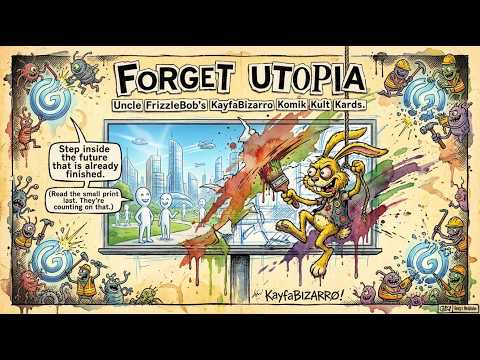
FORGET UTOPIA — KayfaBizarro song
Hopium Lane · Forget Utopia
Deck A · Forget Utopia — the song for the Hopium row. Print, cut, and play it free.

The second deck is Doom, the dark sheet, heavy with ink, and it sells you the opposite: not a finished future but a lost one, on a loop, with ads. The Doomsday Clock, The Perpetual Almost, The Frozen Watcher. Where Hopium says the future is already done, Doom says it is already over. Both, notice, quietly take the future out of your hands.

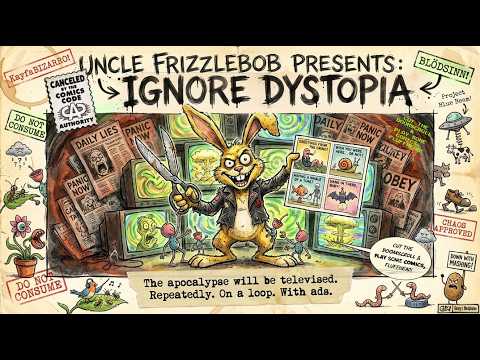
IGNORE DYSTOPIA — KayfaBizarro song
Fearmonger Lane · Ignore Dystopia
Deck B · Ignore Dystopia — the song for the Fearmonger row. Print, cut, and play it free.

The third deck is Protopia, and its title is the whole argument: Protopia in Pencil. In pencil, that is, provisional, erasable, not yet fixed, the opposite of the finished city. Its cards are not promises but small instructions: The Held Breath, The Reclaimed Second. "Place attention on purpose. Take one second back, then another." It is the only one of the three futures that gives your hand something to do instead of something to believe.

EMBRACE PROTOPIA — KayfaBizarro song
Curiosity Lane · Embrace Protopia
Deck C · Embrace Protopia — the song for the Curiosity row. Print, cut, and play it free.

Three moods, three palettes, one world drawn three times. Before a single card is played, your hand already knows whether it is holding a seduction, a threat, or an exercise. That is colour doing the storytelling, exactly as McCloud promised it could.

The teeming margin

Look closely and the margins, between the panels, teem: aliens, plants in pots, animals, little scribbled asides, footnotes to Aby Warburg and McCloud, a whole seek and find picture. When you cut, some of it ends up as scraps on the table, and that is not a loss, it is the point. The teeming margin is the unfinished texture of these comics, rough on purpose, a refusal of the glossy, sanded down surface.

Two evenings, and the moment it caught fire

Three of us sat down to test it. The first evening we played the decks one at a time, each on its own, and each one bent our stories into a different shape. Hopium made us run in circles, because every card promises a payoff that never lands. Doom funnelled everything toward the same grim ending. Only Protopia opened the room up, because its cards propose actions instead of asserting states. Breathe. Pause. Take the second back. The deck that promised the least gave us the most to play.

The second evening we did the obvious reckless thing. We threw all three cut piles together and shuffled them into one deck. That was a different and much better game. Now The Finished City landed next to The Doomsday Clock in the same hand, and the collision forced a turn no single card contained: the perfect city that starts to crumble in the very moment it is finished. That spark between two cards is closure again, only now it jumps between two whole moods.

Apart, the three decks are three tidy theses about the future: it is finished, it is doomed, it is unfinished. Shuffled, they stop being theses and start being an argument. And an argument, it turns out, tells a far better story than any thesis. Nobody at the table is being told what to think. You keep getting fresh contradictions in your hand, and together you have to make something human of them.

A family the rabbit politely forgets to mention

Scissors have ancestors. In 1920 Tristan Tzara pulled cut up newspaper words from a hat to write a Dada poem, the first cheerful claim that order can be left to luck. In the 1950s Brion Gysin and William Burroughs turned that into the cut up technique, slicing finished pages apart to find the meaning the author never planned. Raymond Queneau cut ten sonnets into strips so readers could build a hundred thousand billion of their own. The Fluxus artists wrote instructions that only became artworks when somebody performed them.

The idea, in other words, is old: the work gets finished by the person holding it. What KayfaBizarro adds is not the cut but the company. A table, two dice, a few people. The avant garde cut alone in the studio, against meaning. KayfaBizarro cuts three handed at the kitchen table, for meaning, and turns a radical gesture from the sixties into a party game you can actually play on a Tuesday without it smelling of seminar. Not smaller for that. Warmer.

What the page can and cannot do

As a game, it keeps its promise. It turns reading into doing, meaning into negotiation, and a few friends into a group willing to risk a story together for an hour. That little republic of the table is not a democracy, King Kayfabian stays a benevolent fallback, but it is something rarer: a voluntary agreement to share one reality for a while.

And here is the honest catch. A printed sheet on its own does nothing. The game lives in the cutting, the shuffling, the table. The page is a billboard for a performance that happens at your table. Which is exactly why it ends not with a conclusion but with a deck in your hands.

The move that lies open

The best evening was the shuffled one, and even then we only had three futures to mix. Three moods, three palettes, three ready made attitudes.

So what is the fourth deck? Not Hopium, not Doom, not even Protopia, but a small stack of blank cards. In pencil, as the title promised all along, but this time with no drawing on them at all. The nerve to hand the table an empty card and trust the people sitting there to draw the future that nobody printed for them.

That is the whole thing in one gesture. It will not tell you which future is right. It hands you a pair of scissors, three contradictory futures, and a blank card, and it bets that you and your friends can think of something better than any of them.

Now your move

KayfaBizarro is free. Print it, pay what you want, cut it up, and play. The decks, the rules, and a growing pile of these comics live at KayfaBizarro.Pages.dev.

You will need three things a download cannot give you: a few friends, a pair of scissors, and the willingness to be wrong out loud. The rabbit will handle the rest.

Find your nearest lever. What is your one percent today?

The triptych on the wall — “Utopia – Aufbruch oder Untergang?”, Kunstverein Wunstorf, July 2026. Tap to enlarge.

A companion reading after Scott McCloud and Thierry Groensteen, based on the KayfaBizarro Cut & Play decks. KayfaBizarro and MedKayfab are free print, cut and play comics by Georg von Westphalen. The book "Hilfe, ich bin ein Mensch!" is published by Westend Verlag.

Protopia

Drei Zukünfte, eine Schere

Wie ein Comic sich als Spiel entpuppt, das man mit eigener Hand zu Ende bringt.

Eine kurze Lektüre für alle, die gerade ein Deck heruntergeladen haben und jetzt eine Schere in der Hand halten. Keine Ausstellung nötig.

Du hältst einen Comic in der Hand, der zerschnitten werden will.

Über die Panels laufen gepunktete Linien. Unten, in fröhlichen Großbuchstaben, ein Befehl: „Zerschneide diesen Comic und spiel die Zukunft." Ein Cartoon-Hase in der Ecke wirkt begeistert von der Idee. Die meiste Kunst will bewundert und in Ruhe gelassen werden. Diese hier verlangt nach einer Schere.

Diese eine Anweisung ist der ganze Trick, und es lohnt sich, hier kurz innezuhalten, denn sie tut mit dem Comic leise etwas, das die Lehrbücher nicht kommen sahen.

Was du eigentlich vor dir hast

Es heißt Cut & Play Comics, und sein Zeremonienmeister ist Onkel FrizzleBob, ein aufmüpfiger Cartoon-Hase mit Meinungen über die Zukunft und wenig Geduld für Leute, die sie verkaufen.

Jeder Bogen ist dicht mit kleinen, handgezeichneten Karten in Aquarell und kratziger Tusche, und jede trägt einen Namen wie eine kleine Behauptung: The Finished City, The Doomsday Clock, The Held Breath. Es sieht aus wie ein leicht durchgeknallter Comic. Ist es aber nicht ganz. Die gepunkteten Linien verraten den Rest.

Der Twist: das ist kein Comic, das ist ein Deck

Was du ausgedruckt hast, ist der ungeschnittene Bogen eines Kartenspiels. „Cut & Play" ist kein Slogan, es ist die Bauanleitung. Schneide entlang der Linien, und die Panels fallen dir als Kartendeck in die Hand. Was wie Bildunterschriften aussah, sind die zwei Zeilen, die jede Karte ins Spiel trägt: POWER, was die Karte kann, und LORE, was sie will.

Das Spiel trägt einen treffenden Namen: Social Story-Wrestling. Ein paar Freunde setzen sich hin und bauen gemeinsam eine Geschichte, Karte für Karte. Niemand gewinnt. Es geht um eine Geschichte, die irgendwohin läuft, wohin keiner geplant hatte. Zwei Würfel steuern sie, einer für die Stimmung (tragisch, komisch, absurd), einer, der die Geschichte vom Anfang zum Finale schiebt. Was gerade gilt, handelt ihr am Tisch gemeinsam aus, laut, mit den Social Calls. Es gibt zwar eine Schiedsrichterrolle, King Kayfabian, die nach jedem Zug an die nächste Person weiterwandert, aber sie greift nur ein, wenn ihr euch gar nicht einig werdet. Das Wort Kayfabe kommt aus dem Wrestling: die stille Übereinkunft, das Inszenierte als echt zu behandeln, obwohl alle am Tisch wissen, dass es inszeniert ist. Auf diese Übereinkunft einigt ihr euch nicht per Handschlag, sondern einfach per Konvention.

Ein kleines Stück Comic-Theorie macht den Zauber lesbar. Zwischen zwei Comic-Bildern liegt immer eine Lücke. Scott McCloud nennt sie den Rinnstein, den schmalen weißen Zwischenraum zwischen zwei Panels, und er hat aus einer Beobachtung eine Laufbahn gemacht: Der Leser füllt diese Lücke im eigenen Kopf, er ergänzt das Stück Geschichte, das zwischen Panel und Panel passiert. Dieser kleine Akt der Vorstellung heißt bei ihm Closure. Normalerweise vollzieht ihn ein Leser still, allein. KayfaBizarro nimmt diese private Lücke und macht eine gepunktete Linie daraus. Die Closure steckt nicht mehr im Kopf, sie steckt in deinen Händen, und du vollziehst sie mit anderen, laut, an einem Tisch.

Das ist der Zug. Aus einem stillen Akt des Lesens wird ein gemeinsamer Akt des Schneidens. Kein Autor reicht dir die Bedeutung fertig. Du baust sie selbst zusammen.

Drei Zukünfte, drei Geschmacksrichtungen

Es gibt drei Decks, und du verstehst sie mit den Fingern, bevor der Kopf nachkommt. Gleicher Zeichner, gleiche warme Mischung aus Aquarell und Tusche, derselbe wiederkehrende Hase. Was sich ändert, ist das Wetter.

Das erste Deck ist Hopium, der hellste, glänzendste, verführerischste Bogen, gemalt in der Palette der Werbung: Regenbogen, gläserne Skylines, Oberflächen, die glänzen. Seine schärfste Karte ist The Moving Launch Date, auf der „Q3 2024" durchgestrichen wird zu „2025", dann „2026", dann nur noch „SOON". Eine Zukunft als Dauer-Vorbestellung.

FORGET UTOPIA — KayfaBizarro-Song
Hopium Lane · Forget Utopia
Deck A · Forget Utopia — der Song zur Hopium-Reihe. Frei zum Drucken, Schneiden und Spielen.

Das zweite Deck ist Doom, der dunkle Bogen, schwer von Tusche, und es verkauft dir das Gegenteil: keine fertige Zukunft, sondern eine verlorene, in Dauerschleife, mit Werbung. The Doomsday Clock, The Perpetual Almost, The Frozen Watcher. Wo Hopium sagt, die Zukunft sei schon fertig, sagt Doom, sie sei schon vorbei. Beide nehmen dir die Zukunft leise aus der Hand.

IGNORE DYSTOPIA — KayfaBizarro-Song
Fearmonger Lane · Ignore Dystopia
Deck B · Ignore Dystopia — der Song zur Fearmonger-Reihe. Frei zum Drucken, Schneiden und Spielen.

Das dritte Deck ist Protopia, und sein Titel ist das ganze Argument: Protopia in Pencil. Mit dem Bleistift, also vorläufig, radierbar, noch nicht festgeschrieben, das Gegenteil der fertigen Stadt. Seine Karten sind keine Versprechen, sondern kleine Anweisungen: The Held Breath, The Reclaimed Second. „Richte deine Aufmerksamkeit mit Absicht. Hol dir eine Sekunde zurück, dann noch eine." Es ist die einzige der drei Zukünfte, die deiner Hand etwas zu tun gibt statt etwas zu glauben.

EMBRACE PROTOPIA — KayfaBizarro-Song
Curiosity Lane · Embrace Protopia
Deck C · Embrace Protopia — der Song zur Curiosity-Reihe. Frei zum Drucken, Schneiden und Spielen.

Drei Stimmungen, drei Paletten, eine Welt dreimal gezeichnet. Bevor eine einzige Karte gespielt ist, weiß deine Hand schon, ob sie eine Verführung, eine Drohung oder eine Übung hält. Das ist Farbe, die erzählt, genau wie McCloud es versprochen hat.

Das Wimmelbild am Rand

Schau genau hin, dann siehst du es. In den Rändern, zwischen den Panels, wimmelt es: Aliens, Topfpflanzen, Tiere, kleine hineingekritzelte Witze, Fußnoten an Aby Warburg und McCloud, ein ganzes Suchbild. Beim Schneiden bleibt ein Teil davon als Schnipsel auf dem Tisch liegen, und das ist kein Verlust, sondern Absicht. Das Wimmelbild ist die unfertige Textur dieser Comics, roh mit Absicht, eine Absage an die glattgebügelte Hochglanz-Oberfläche.

Zwei Abende, und der Moment, in dem es zündete

Wir waren zu dritt und haben es ausprobiert. Am ersten Abend spielten wir die Decks einzeln, jedes für sich, und jedes bog unsere Geschichten in eine andere Form. Hopium ließ uns im Kreis laufen, weil jede Karte eine Belohnung verspricht, die nie kommt. Doom trichterte alles auf dasselbe düstere Ende. Erst Protopia öffnete den Raum, weil seine Karten Handlungen vorschlagen statt Zustände zu behaupten. Atme. Halt inne. Hol dir die Sekunde zurück. Das Deck, das am wenigsten versprach, gab uns am meisten zu spielen.

Am zweiten Abend taten wir das offensichtlich Leichtsinnige. Wir warfen die drei geschnittenen Stapel zusammen und mischten sie zu einem Deck. Das war ein anderes und viel besseres Spiel. Jetzt lag The Finished City neben The Doomsday Clock in derselben Hand, und der Zusammenprall erzwang eine Wendung, die keine Karte allein enthielt: die perfekte Stadt, die im selben Moment zu zerfallen beginnt, in dem sie fertig wird. Dieser Funke zwischen zwei Karten ist wieder Closure, nur springt er jetzt zwischen zwei ganzen Stimmungen.

Getrennt sind die drei Decks drei ordentliche Thesen über die Zukunft: sie ist fertig, sie ist verloren, sie ist unfertig. Gemischt hören sie auf, Thesen zu sein, und werden ein Streitgespräch. Und ein Streitgespräch erzählt eine weit bessere Geschichte als jede These. Niemandem am Tisch wird gesagt, was er denken soll. Ihr bekommt immer neue Widersprüche in die Hand und müsst gemeinsam etwas Menschliches daraus machen.

Eine Familie, die der Hase höflich verschweigt

Die Schere hat Vorfahren. 1920 zog Tristan Tzara für ein Dada-Gedicht zerschnittene Zeitungswörter aus dem Hut, die erste fröhliche Behauptung, dass man die Reihenfolge dem Zufall überlassen darf. In den fünfziger Jahren machten Brion Gysin und William Burroughs daraus die Cut-up-Technik: fertige Seiten zerschneiden und neu zusammenlegen, um einen Sinn zu finden, den der Autor nie geplant hatte. Raymond Queneau schnitt zehn Sonette in Streifen, damit Leser sich hunderttausend Milliarden eigene bauen können. Die Fluxus-Künstler schrieben Anweisungen, die erst zum Kunstwerk wurden, wenn jemand sie ausführte.

Die Idee ist also alt: Das Werk wird von dem fertiggemacht, der es in der Hand hält. Was KayfaBizarro hinzufügt, ist nicht der Schnitt, sondern die Gesellschaft. Eine Runde, zwei Würfel, ein Tisch. Die Avantgarde schnitt allein im Atelier, gegen den Sinn. Hier schneidet ihr zu dritt am Küchentisch, für den Sinn, und macht aus einer radikalen Geste der Sechziger ein Gesellschaftsspiel, das man an einem Dienstag tatsächlich spielen kann, ohne dass es nach Seminar riecht. Nicht kleiner dadurch. Wärmer.

Was die Seite kann und was nicht

Als Spiel hält es sein Versprechen. Es macht aus Lesen ein Tun, aus Bedeutung ein Aushandeln, und aus ein paar Freunden eine Runde, die für eine Stunde gemeinsam eine Geschichte riskiert. Diese kleine Republik des Tisches ist keine Demokratie, King Kayfabian bleibt ein wohlwollender Notbehelf, aber sie ist etwas Selteneres: eine freiwillige Übereinkunft, für eine Weile eine Wirklichkeit zu teilen.

Und hier ist der ehrliche Haken. Ein gedruckter Bogen allein tut nichts. Das Spiel lebt im Schneiden, im Mischen, am Tisch. Die Seite ist die Reklame einer Aufführung, die an deinem Tisch stattfindet. Genau deshalb endet sie nicht mit einem Fazit, sondern mit einem Deck in deinen Händen.

Der Zug, der offen liegt

Der beste Abend war der gemischte, und selbst da hatten wir nur drei Zukünfte zu mischen. Drei Stimmungen, drei Paletten, drei fertige Haltungen.

Was also ist das vierte Deck? Nicht Hopium, nicht Doom, nicht einmal Protopia, sondern ein kleiner Stapel leerer Karten. Mit dem Bleistift, wie der Titel die ganze Zeit versprochen hat, aber diesmal ganz ohne Zeichnung. Der Mut, der Runde eine leere Karte zu reichen und den Leuten am Tisch zuzutrauen, die Zukunft selbst zu zeichnen, die ihnen niemand gedruckt hat.

Das ist das Ganze in einer Geste. Es sagt dir nicht, welche Zukunft die richtige ist. Es reicht dir eine Schere, drei widersprüchliche Zukünfte und eine leere Karte, und es wettet, dass dir und deinen Freunden etwas Besseres einfällt als alle drei.

Jetzt bist du dran

KayfaBizarro ist kostenlos. Druck es, zahl was du willst, schneide es zu und spiel. Die Decks, die Regeln und ein wachsender Stapel dieser Comics liegen auf KayfaBizarro.Pages.dev.

Drei Dinge brauchst du, die ein Download dir nicht geben kann: ein paar Freunde, eine Schere und die Bereitschaft, sich laut zu irren. Den Rest macht der Hase.

Finde deinen nächsten Hebel. Was machst du heute um ein Prozent besser?

Das Triptychon an der Wand — „Utopia – Aufbruch oder Untergang?“, Kunstverein Wunstorf, Juli 2026. Zum Vergrößern tippen.

Eine Begleitlektüre nach Scott McCloud und Thierry Groensteen, auf Grundlage der KayfaBizarro Cut & Play-Decks. KayfaBizarro und MedKayfab sind freie Print-, Cut- und Play-Comics von Georg von Westphalen. Das Buch „Hilfe, ich bin ein Mensch!" erscheint im Westend Verlag.

Uncle FrizzleBob's Komik Kard Kult

KayfaBizarro Free Style Rules

Cut & Play Comic · Story-Wrestling Edition · 1-6 Humans · 20-60 Min · CC BY-NC-SA 4.0

"This is not a game you play. It's a game you use. Nobody wins. Nobody loses. You'll defend an idea you hated fifteen minutes earlier — because the story needs you to. That's the plan. Stay fluffy."Uncle FrizzleBob
The Comic

Flip through every page inline, or read the full rules below.

Download the Comic (PDF)
Start Here

KayfaBizarro is a storytelling card game for 1–6 players. You take turns building one shared story, card by card. Each turn, the next player judges. Nobody wins or loses — you make something up together and see where it goes.

Key terms: Actor = the card you speak as · Stage = three shared Scene slots · Quest = where the story's heading · King Kayfabian = the rotating judge · Kayfabe = treat the made-up as real.
Your first round, right now — Deal 3 cards each. Everyone reveals one as their Actor and says who it is. Flip one more card face-up as the Quest: that's the goal the story is heading for. Then take turns adding to the story until you get there. Skip the dice this round. That's the whole game — the rest is just detail.
What you need
Cards — 15–20 KayfaBizarro cards per player, shuffled into one shared pile. Every card can be an Actor, Scene, or Quest. Rule of thumb: an Actor if it's a who, a Scene if it's a where or what, a Quest if it's a goal.
Two D6 — One Story-Mode Die, one Quest Die. Both stay visible.
1–6 People — And a table. No board. No pawns.
Blank paper & a pen (optional) — Doodle and graphic-record as you play — group anti-journaling, not just solo. The sheet becomes the group's running record, and at the Finale, the official version.
KayfaBizarro Quick-Rules one-pager (EN)
The whole game on one page — print it, cut along the lines, play.
The First Cut

Before anyone tells a story, everyone cuts together. Each person takes a printed sheet and a pair of scissors and turns it into a deck of cards. This is not prep. It is already the first move.

You destroy something finished to get something playable. It is the best ice-breaker at the table: hands busy, eyes free, talking comes easier. And you meet every card once, because it passed through your fingers on the way in.

Confetti of the Cut, don't bin the off-cuts. The margins are full of Uncle FrizzleBob’s little gags — the scraps are your free art supply. Can’t (or won’t) draw? Snip a marginalia doodle and glue it onto a DIY card, or onto one you’re defacing.
FrizzleTips · optional
1 · Glue it down — Glue the cards onto cardboard — cereal boxes, packaging, anything flat, ideally stolen from work. They shuffle better and survive high-octane stories and wild party nights.
2 · Make it yours — KayfaBizarro is unfinished by design: write a stupid joke on a card, scribble an ugly cartoon, deface it with a cut-up gag from the gutter. Be wild, go full KayfaBizarro.
3 · Crossover Deck (Moshpit Mode) — Shuffle two or more editions into one pile. The stranger the mix, the better the Kayfabe. ⚠ Warning: mixing KayfaBizarro comics may cause cognitive dissonance, ontological vertigo, the spread of contraband ideas, and critical thinking. Side effects include connecting dots in the gutter and questioning official Kayfabe stories. In case of emergency, call your trusted mainstream-narrative wrestler or local spin doctor.
4 · Rules are buffets, not laws — Hate one? Cut it. Invent a Kayfabe rule mid-game and defend it like scripture. (Bring pencil, rubber & scissors.)
5 · DIY cards — Make your own (draw, write, collage). Smuggle them into the deck at the First Cut (contraband welcome), slip them into a Crossover Deck with everyone's nod, or swap one for a hand card and play it with the usual Card Ritual.
The Setup

Deal the cards, pick your Actors, reveal the Quest — then the first player goes.

1DealGive 3 secret cards to each player. Two minutes total.
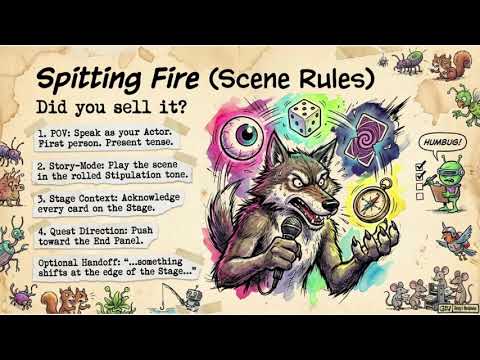
2ActorsEach player picks 1 card, reveals it face-up, and runs the Card Ritual (Show it · Spin it · Sell it). This card is your Actor.
3QuestThe fluffiest player (you know who) draws a Quest card and runs the Card Ritual — and frames the die: what reaching 6 looks like, what sliding to 1 looks like. Set the Quest Die to 1.
4StageThe Stage starts empty. Three Scene slots, all open.
5GoThey take the first turn.
The Card Ritual

Whenever someone introduces a new card — an Actor, Scene, or Quest — they run the Ritual. Think: wrestling entrance. Three steps, thirty seconds, in character.

Show itPoint at the card. Show it to everyone — name and picture. This is who just entered.
Spin itSpin a quick backstory: what is it, what does it want? Read the Lore (the small text) or invent from the image — colored by your rolled Mode.
Sell itDon't explain it — sell it. Commit like it's the only real thing in the room. (A card's Power is played as kayfabe, not literally.)
Always — Every card, every time — Actors, Scenes, Quests.
Your Turn

Every turn is the same five beats — in order, in character, out loud. After a round or two it runs by itself.

The Five Beats~2 minutes per player
1Roll the Story-Mode DieWhatever it shows is your tone this turn. Commit.
2Play a CardPlay a card from your hand onto a Stage slot (fill or overwrite it), or use it to replace your Actor (→ Actor Switch). Then bring it in with the Card Ritual. (A card's Power is played as kayfabe, not literally: narrate it into the story, don't invoke it like a stat. Playing a Power too literally may alienate your fluffy friends, which, now and then, is exactly the point.)
3Tell your storySpeak as your Actor, first person — you don't play your Actor, you are them. Weave the three Stage cards into one story — one panel each, any order, pointing at each (the finger-rule keeps everyone on track) — in the Mode you rolled. Land the last panel on the Quest: end on a believable push toward it. First rounds, the Stage isn't full yet: weave what's already there, and it fills up as you play.
4Draw a CardDraw one from the shared deck so you're holding three again for next turn.
5VerdictThe other players and the King Kayfabian decide, by social call, whether you sold it. The King moves the Quest Die: a hard push (+2), a push (+1), a hold (0), or a twist (−1). At 6: the Finale. Then active player and King rotate one seat clockwise.
A Sample Turn

Cards from the three decks. Mira's Actor is The Frozen Watcher. On the Stage: The Finished City, The Doomsday Clock, The Held Breath. Quest: The Nearest Lever, find the one thing within reach. Quest Die on 4. Mira rolls a 3: Absurd.

She speaks as her Actor — first person, pointing at each card as she weaves it in (the finger-rule keeps everyone on the beats): “I am the Frozen Watcher of Utopia — but since they finished the city in 1947, there's been no future left to watch, or watch out for. So I held my breath… until the fearmongers' Doomsday Clock started ticking backwards. They panicked as the protopian probability-fields collapsed into countless futures. So maybe — sometimes — the simple act of holding your breath is the nearest lever: it opens a surprising path to an unscripted future.”

All five cards woven in, fully committed to the Absurd. The other players and the King Kayfabian cheer — a hard push, +2. The Quest Die lands on 6: the Finale. KayfaBINGO!

King Kayfabian

After each story, the next player becomes King Kayfabian — judge and audience. Play your story to them. Their verdict moves the Quest.

One verdict, brief, in character — a hard push (+2), a push (+1), a hold (0), or a twist (−1). One hand on the Quest Die. No debate, no appeal. Then the crown passes on. Everyone is King once per round.

The Quest Die

The Quest Die tracks where the arc is — from Setup (1) to Finale (6). Only the King moves it, after each story.

Heads up: you never roll the Quest Die; it's a tracker you push, not a throw.
1SetupEstablish the world.
2SparkSomething disrupts.
3PursuitStakes grow.
4TrialsComplications mount.
5OrdealThe hardest moment.
6FinaleIt ends. The Quest must resolve.
The King's Verdict
+2Hard pushUse sparingly — a decisive leap forward.
+1PushThe default move. Standard progression.
0HoldLinger here. Build character, not plot.
−1TwistReframe what just happened.
Note — Drop below 1 and the Quest fails: no Finale, no loot — the collapse is the story. Reach 6 and the next player's turn is the Finale.
The Story-Mode Die

Roll the Story-Mode Die at the start of your turn. Not optional. Commit to it. If the Mode clashes with your story, don't smooth it over — play the clash out loud and let the wrong tone bend the scene. That's your turn.

1
Tragic
Loss is real. Push forward anyway.
2
Comic
Things go wrong. It's your fault. Play the gap.
3
Absurd
The impossible is normal. Don't explain it.
4
Heroic
Your Actor is right for this moment. Play the peak.
5
Mystical
Something's happening beneath the surface.
6
Forbidden
Cross the line the story's been avoiding. Sell it.
The Stage

The Stage is three Scene card slots — the shared reality everyone is playing inside. All three start empty.

Empty slot — Fill it with a Scene card from your hand (Card Ritual, then play).
Stage full (3/3) — Overwrite an existing slot with a yes-and: choose one to discard and replace it.
Actor Switch

Instead of a Scene card, you can play a new Actor in front of you at any time, replacing your current one. Your old Actor exits or becomes a background figure. Switch your voice and posture. The Stage is unchanged.

The Finale

When the Quest Die hits 6, the next player's turn is the Finale turn. Same 5 beats — but the Quest must resolve in the story. Happy, tragic, absurd — but not just an ending: the return. You come back to the world you set out from — and what you bring back is what changes it.

After the Finale
Kayfabulation Loot — Forget gold, collect the experience. Your haul is the kayfabe you confabulated together: the best gags, the absurd twists, the gaping plot holes, the heroic fails, the epic Blödsinn, the story that should never have been told … Grab pens, scissors and glue: draw, write and paste up your kayfabulations. That's your quest loot, and it's yours to keep.
Clear — The player who told the Finale clears the Stage by choice: keep any Scene that should haunt the next story, drop the rest.
New Quest — The Finale-teller launches the next Quest — draw it, run the Card Ritual, and frame the die: what reaching 6 looks like, what sliding to 1 looks like, so everyone pushes the same card the same way. Set the Quest Die to 1.
Reset — Play resumes in normal rotation. A new episode begins.
Optional Rules
Safe floor — Add a "never below 1" floor — Quest Fails become impossible. For lighter play.
Trophy rule — Whoever tells the Finale keeps the Quest card. First to 3 wins the session.
Social Calls

Any player can make one — but only after a story has finished, before the next player starts, so nobody breaks the active player's flow. The calls inform the King's ruling; the King has the final say.

KayfaBINGO!
That landed. Pure praise. Active player draws an extra card.
KayfaBOGGLE?
I'm lost. One concrete question. Active player answers in 1–2 sentences, in character.
KayfaBONGO!
A player narrated their Power as a mechanic ("blocks 70%", "+2 damage"). Anyone calls it. Active player restates as story, not transaction.
BLÖDSINN!
Rule broken: out of character, Scene forgotten, Mode ignored. The King rules. No debate. If upheld: turn voided — no Quest Die move.
Timing — Right after the story, any player can call. The King (already next up) rules — BLÖDSINN! upheld → turn voided; otherwise +2, +1, 0, or −1 — then takes their turn.
Powers & Cards

Nothing on a card is a rule. A card's Power is a cue — play it as a loose effect in the story, or ignore it. Nothing to track, no exceptions to remember.

Perform it, don't announce it. Turn the Power into something that happens in the story — not a move you call out by name.

Solo Play

KayfaBizarro also plays solo — slower and quieter, one person building the whole story. You're not playing against yourself. You're playing against the situation. You hold three roles: your Actor, the world, and the Resistance — whatever won't simply yield.

Solo Setup
1ActorPlace 1 Actor card face up. This is you.
2StageOpen three Scene slots, as always.
3QuestDraw 1 Quest card and set the Quest Die to 3 — mid-range, so it can travel both ways.
4HandHold 3 cards from the shared deck.
5TraceKeep paper and pencil to jot each beat.
The Solo Quest Die — Start at 3, move each round. +1 pressure builds (comfortable, evasive). −1 pressure releases (coherent but uncomfortable). Reaches 6 → Finale. Below 1 → Quest Fail. Either way: the session ends.
Four solo gears
A · Journal — One card a round, one honest line linking Actor → Stage → Quest. Safe and evasive: +1. Honest and pointed: −1.
B · Reasoning — Focus under pressure. Each card carries a modifier or a value to solve; you may only narrate once you've met its condition.
C · Solo Adventure — Decision trees and risk. Each Quest offers 2–3 actions; roll 2×D6 against a bar you set (easy 5+, risky 7+, dangerous 9+).
The Protopia Deck

Browse the Protopia deck — a KayfaBizarro expansion about utopian futures and the people who break them. Free to download.

Download free on Gumroad
Glossary
Kayfabe
The iron agreement to treat everything staged, invented, and improvised at the table as absolute, unshakable reality. Bring a card into play and you defend its existence — vehemently, no ironic distance.
Bizarro
The literary genre of the absurd and grotesque — rooted in Weird Tales, surrealism, and the pulps. Your licence to build a deliberately strange mirror-world that defies the laws of nature but obeys its own merciless rules at the table.
Kayfabulation
Kayfabe + confabulation. The bizarre shared reality that emerges from the Quest and your stories, and the loot you keep.
King Kayfabian
The rotating judge — the next player. Weighs each story, moves the Quest Die, has the final say. Everyone is King once per round.
Actor
The card you embody this turn — your perspective in the story. Swap it any turn via an Actor Switch.
Quest Die
A story compass from Setup (1) to Finale (6). Only the King moves it.
Story-Mode Die
Rolled at the start of your turn — it sets your tone: Tragic, Comic, Absurd, Heroic, Mystical, or Forbidden. Commit to whatever it shows.
Card Ritual
The entrance protocol: Show it · Spin it · Sell it. Every card. Every time.
The Stage
Three Scene card slots. The shared reality. Starts empty. Fills up. Gets overwritten.
Quick Reference
Every turn — 5 beats
1 Roll the Story-Mode DieWhatever it shows — commit to it
2 Play a Carda card from hand → Stage slot or Actor Switch — then the Card Ritual
3 Tell your storyas your Actor (POV) · weave the 3 Stage cards · land on the Quest
4 Draw a Carddraw back up to 3 for next turn
5 Verdictdid you sell it? King moves the Quest Die +2 / +1 / 0 / −1 · BLÖDSINN! → no move · at 6: Finale · then rotate clockwise
Optional · Level-up
FrizzleBob's KayfabeTips
How to Kayfabe Your Bizarro Fluff (with Plausible Deniability)
Therefore / But, never and-then — The story is a movie running in everyone’s heads at once — and you’re driving it. Each beat lands because you link it: therefore (so this happens) or but (except it twists). “And then… and then” lets the movie stall; therefore and but keep it moving — this, therefore that, but this, therefore that. Even your most absurd turn feels caused — because you made the cause.
Yes, and — Whatever’s on the Stage is true now — don’t argue it away, grab it and push it somewhere weirder. Blocking kills the bit; building feeds it.
We follow people, not props — A card isn’t a label, it’s a soul with an opinion. Give your Actor a want, a wound, a grudge — that’s the hook nobody resists.
The weirder the card, the straighter your face — Anyone can wink. The art is selling a backwards-ticking doomsday clock like it’s your tax bill. Doubt is the only thing that kills kayfabe.
One real picture beats ten big ideas — “The clock ticks backwards” lands. “The nature of time” puts us to sleep. Reach for what you can see, smell, point at.
Onkel FrizzleBobs Komik Kard Kult

KayfaBizarro Free-Style-Regeln

Cut & Play Comic · Story-Wrestling Edition · 1-6 Menschen · 20-60 Min · CC BY-NC-SA 4.0

"Das ist kein Spiel, das du spielst. Es ist ein Spiel, das du benutzt. Niemand gewinnt. Niemand verliert. Du wirst eine Idee verteidigen, die du fünfzehn Minuten vorher gehasst hast — weil die Geschichte dich braucht. Das ist der Plan. Bleib flauschig."— Onkel FrizzleBob
Der Comic

Blättere jede Seite inline durch, oder lies die vollständigen Regeln unten.

Comic als PDF
Fang hier an

KayfaBizarro ist ein Erzähl-Kartenspiel für 1–6 Spieler. Reihum baut ihr eine gemeinsame Geschichte, Karte für Karte. Jeden Zug urteilt die nächste Person. Niemand gewinnt oder verliert — ihr denkt euch zusammen etwas aus und schaut, wohin es läuft.

Schlüsselbegriffe: Actor = die Karte, als die du sprichst · Bühne = drei geteilte Scene-Slots · Quest = wohin die Geschichte läuft · King Kayfabian = der rotierende Richter · Kayfabe = das Erfundene als echt behandeln.
Deine erste Runde, sofort — Jedem 3 Karten geben. Alle decken eine als ihren Actor auf und sagen, wer das ist. Eine weitere Karte offen als Quest: das ist das Ziel, auf das die Geschichte zuläuft. Dann reihum die Geschichte weiterbauen, bis ihr dort seid. Würfel diese Runde weglassen. Das ist das ganze Spiel — der Rest ist nur Detail.
Was ihr braucht
Karten — 15–20 KayfaBizarro-Karten pro Person, in einen gemeinsamen Stapel gemischt. Jede Karte kann ein Actor, eine Scene oder eine Quest sein. Daumenregel: als Actor, wenn sie ein Wer ist, als Scene, wenn sie ein Wo oder Was ist, als Quest, wenn sie ein Ziel ist.
Zwei W6 — Ein Story-Mode-Würfel, ein Quest-Würfel. Beide jederzeit sichtbar.
1–6 Personen — Und einen Tisch. Kein Brett. Keine Pawns.
Blankes Papier & ein Stift (optional) — Doodle und graphic-record während der Züge — Group-Anti-Journaling, nicht nur Solo. Das Blatt wird das laufende Protokoll der Gruppe — und am Finale die offizielle Version.
KayfaBizarro Quick-Rules OnePager (DE)
Das ganze Spiel auf einer Seite — ausdrucken, entlang der Linien schneiden, spielen.
Der erste Schnitt

Bevor jemand eine Geschichte erzählt, schneidet ihr gemeinsam. Jede:r nimmt ein gedrucktes Blatt und eine Schere und macht daraus ein Kartendeck. Das ist keine Vorbereitung. Das ist schon der erste Zug.

Du zerstörst etwas Fertiges, um etwas Spielbares zu bekommen. Der beste Eisbrecher am Tisch: die Hände beschäftigt, die Augen frei, das Reden fällt leichter. Und jede Karte begegnet dir einmal, weil sie auf dem Weg ins Spiel durch deine Finger ging.

Konfetti des Schnitts — wirf die Schnipsel nicht weg. Die Ränder sind voller kleiner Gags von Onkel FrizzleBob — die Schnipsel sind dein gratis Zeichenmaterial. Kannst (oder willst) du nicht zeichnen? Schneid ein Marginalien-Doodle aus und kleb es auf eine DIY-Karte oder auf eine, die du verunstaltest.
FrizzleTips · optional
1 · Aufkleben — Kleb die Karten auf Pappe — Müsliboxen, Verpackungen, alles Flache, am besten aus dem Büro geklaut. Sie mischen besser und überstehen High-Octane-Stories und wilde Partynächte.
2 · Mach's zu deinem — KayfaBizarro ist unfertig by design: schreib einen blöden Witz auf eine Karte, kritzel einen hässlichen Cartoon, verunstalte sie mit einem Cut-up-Gag aus dem Gutter. Sei wild, geh full KayfaBizarro.
3 · Crossover Deck (Moshpit Mode) — Misch zwei oder mehr Editionen zu einem Stapel. Je schräger der Mix, desto besser die Kayfabe. ⚠ Warnung: das Mischen von KayfaBizarro-Comics kann kognitive Dissonanz, ontologisches Schwindelgefühl, die Verbreitung von Schmuggelideen und kritisches Denken auslösen. Nebenwirkungen: Punkte im Gutter verbinden und offizielle Kayfabe-Geschichten hinterfragen. Im Notfall ruf deinen vertrauten Mainstream-Narrativ-Wrestler oder örtlichen Spin-Doctor.
4 · Regeln sind Buffets, keine Gesetze — Eine, die du hasst? Schneid sie raus. Erfind mitten im Spiel eine Kayfabe-Regel und verteidige sie wie die Heilige Schrift. (Bring Bleistift, Radiergummi & Schere mit.)
5 · DIY-Karten — Mach eigene (zeichnen, texten, collagieren). Schmuggle sie beim First Cut ins Deck (contraband welcome), schmuggle sie mit dem Nicken der anderen in ein Crossover Deck, oder tausch eine gegen eine Handkarte und spiel sie mit dem üblichen Card-Ritual.
Das Setup

Karten austeilen, Actors wählen, Quest aufdecken — dann macht die erste Person den Auftakt.

1AusteilenJedem 3 Karten geheim geben. Zwei Minuten insgesamt.
2ActorsJeder zieht 1 Karte, deckt sie offen auf und macht das Karten-Ritual (Show it · Spin it · Sell it). Diese Karte ist dein Actor.
3QuestDie flauschigste Person (du weißt, wer) zieht eine Quest-Karte und macht das Karten-Ritual — und rahmt den Würfel: was die 6 bedeutet, was die 1 bedeutet. Quest-Würfel auf 1.
4BühneDie Bühne startet leer. Drei Scene-Slots, alle offen.
5Los!Sie macht den ersten Zug.
Das Karten-Ritual

Immer wenn jemand eine neue Karte einführt — einen Actor, eine Scene oder eine Quest — macht er das Ritual. Denk: Wrestling-Einzug. Drei Schritte, dreißig Sekunden, in character.

Show itAuf die Karte zeigen. Allen zeigen — Name und Bild. Das ist, wer gerade aufgetreten ist.
Spin itSpinn eine kurze Backstory: was ist das, was will es? Die Lore vorlesen (der kleine Text) oder aus dem Bild erfinden — gefärbt von deinem gewürfelten Mode.
Sell itErklär es nicht — verkauf es. Committe, als wär's das einzig Echte im Raum. (Die Power einer Karte spielst du als Kayfabe, nicht wörtlich.)
Immer — Jede Karte, jedes Mal — Actors, Scenes, Quests.
Dein Zug

Jeder Zug sind dieselben fünf Beats — der Reihe nach, in character, laut. Nach ein, zwei Runden läuft es von selbst.

Die fünf Beats~2 Min pro Spieler
1Story-Mode-Würfel werfenWas er zeigt, ist dein Ton in diesem Zug. Geh rein.
2Karte spielenSpiel eine Karte aus deiner Hand auf einen Bühnen-Slot (frei oder überschreiben) oder ersetz damit deinen Actor (→ Actor-Wechsel). Dann führ sie mit dem Karten-Ritual ein. (Die Power einer Karte spielst du als Kayfabe, nicht wörtlich: erzähl sie in die Geschichte, ruf sie nicht wie einen Stat auf. Eine zu wörtlich gespielte Power kann deine flauschigen Mitspieler verprellen, was hin und wieder genau der Sinn ist.)
3Erzähl deine GeschichteSprich als dein Actor, erste Person — du spielst deinen Actor nicht, du bist er. Web die drei Bühnenkarten zu einer Geschichte — ein Panel je Karte, beliebige Reihenfolge, zeig auf jede (die Finger-Rule hält alle auf Spur) — in dem Mode, den du gewürfelt hast. Lass das letzte Panel auf der Quest landen: ende mit einem glaubhaften Schub darauf zu. In den ersten Runden ist die Bühne noch nicht voll: web, was schon liegt, sie füllt sich beim Spielen.
4Karte ziehenZieh eine Karte vom gemeinsamen Stapel, sodass du wieder drei auf der Hand hast.
5UrteilDie anderen Spieler und der King Kayfabian entscheiden per Social Call, ob du es verkauft hast. Der King bewegt den Quest-Würfel: ein harter Schub (+2), ein Schub (+1), ein Halten (0) oder eine Wendung (−1). Bei 6: das Finale. Dann rücken aktiver Spieler und King einen Platz im Uhrzeigersinn weiter.
Ein Beispielzug

Karten aus den drei Decks. Miras Actor ist The Frozen Watcher. Auf der Bühne: The Finished City, The Doomsday Clock, The Held Breath. Quest: The Nearest Lever — finde das eine Ding in Reichweite. Quest-Würfel auf 4. Mira würfelt eine 3: Absurd.

Sie spricht als ihr Actor — erste Person, auf jede Karte zeigend, während sie sie einwebt (die Finger-Rule hält alle auf den Beats): „Ich bin der Frozen Watcher von Utopia — aber seit sie die Stadt 1947 fertiggestellt haben, gab es für mich keine Zukunft mehr zu bewachen. Also hielt ich die Luft an… bis die Doomsday Clock der Angstmacher rückwärts zu ticken begann. Sie gerieten in Panik, als die protopischen Wahrscheinlichkeitsfelder in unzählige Zukünfte kollabierten. So vielleicht — manchmal — ist das simple Anhalten des Atems der nächste Hebel: er öffnet einen überraschenden Pfad zu einer ungeschriebenen Zukunft.“

Alle fünf Karten verwoben, voll auf Absurd committet. Die anderen Spieler und der King Kayfabian jubeln — ein harter Schub, +2. Der Quest-Würfel landet auf 6: das Finale. KayfaBINGO!

King Kayfabian

Nach jeder Geschichte wird die nächste Person zum King Kayfabian — Richter und Publikum. Spiel deine Geschichte für sie. Ihr Urteil bewegt die Quest.

Ein Urteil, kurz, in character — ein harter Schub (+2), ein Schub (+1), ein Halten (0) oder eine Wendung (−1). Eine Hand am Quest-Würfel. Keine Debatte, kein Einspruch. Dann wandert die Krone weiter. Jeder ist einmal pro Runde König.

Der Quest-Würfel

Der Quest-Würfel verfolgt, wo der Bogen steht — von Aufbau (1) bis Finale (6). Nur der König bewegt ihn, nach jeder Geschichte.

Kurz: den Quest-Würfel würfelst du nie; er ist ein Tracker, den man schiebt, kein Wurf.
1AufbauEtabliert die Welt.
2FunkeEtwas stört.
3VerfolgungDer Einsatz wächst.
4PrüfungenKomplikationen häufen sich.
5TorturDer härteste Moment.
6FinaleEs endet. Die Quest muss sich auflösen.
Das Urteil des Königs
+2Harter SchubSparsam einsetzen — ein entscheidender Sprung nach vorn.
+1SchubDer Standardzug. Standard-Progression.
0HaltenVerweile hier. Bau Figur auf, nicht Plot.
−1WendungRahme neu, was gerade passiert ist.
Hinweis — Fällt er unter 1, scheitert die Quest: kein Finale, keine Beute — der Zusammenbruch ist die Geschichte. Erreicht er 6, ist der Zug der nächsten Person das Finale.
Der Story-Mode-Würfel

Wirf den Story-Mode-Würfel zu Beginn deines Zugs. Nicht optional. Committe dich. Wenn der Modus mit deiner Geschichte kollidiert, bügel ihn nicht glatt — spiel die Kollision laut aus und lass den falschen Ton die Szene verbiegen. Das ist dein Zug.

1
Tragisch
Verlust ist echt. Trotzdem weiter.
2
Komisch
Es geht schief. Du bist schuld. Spiel die Lücke.
3
Absurd
Das Unmögliche ist normal. Erklär es nicht.
4
Heroisch
Dein Actor ist richtig für diesen Moment. Spiel den Gipfel.
5
Mystisch
Unter der Oberfläche passiert etwas.
6
Verboten
Überschreite die Linie, um die sich die Geschichte höflich gedrückt hat. Verkauf es.
Die Bühne

Die Bühne sind drei Scene-Slots — die gemeinsame Realität, in der alle spielen. Alle drei starten leer.

Leerer Slot — Füll ihn mit einer Scene-Karte aus deiner Hand (Karten-Ritual, dann spielen).
Bühne voll (3/3) — Überschreib einen Slot per yes-and: wähl einen zum Ablegen und ersetz ihn.
Actor-Wechsel

Statt einer Scene-Karte kannst du jederzeit eine neue Actor-Karte vor dir ablegen und deine aktuelle ersetzen. Dein alter Actor verlässt die Geschichte oder wird zur Nebenfigur. Wechsle Stimme und Haltung. Die Bühne bleibt unverändert.

Das Finale

Wenn der Quest-Würfel auf 6 steht, ist der Zug der nächsten Person der Finale-Zug. Dieselben 5 Beats — aber die Quest muss sich im Erzählen auflösen. Glücklich, tragisch, absurd — aber nicht bloß ein Ende: die Rückkehr. Ihr kommt in die Welt zurück, aus der ihr aufgebrochen seid — und was ihr mitbringt, ist es, was sie verändert.

Nach dem Finale
Kayfabulation Loot — Vergesst Gold, sammelt die Erfahrung. Eure Beute ist das Kayfabe, das ihr zusammen fabuliert habt: die besten Gags, die absurden Twists, die klaffenden Plot Holes, die heroischen Fails, der epische Blödsinn, die Geschichte, die niemals hätte erzählt werden dürfen … Schnappt euch Stifte, Schere und Kleber: zeichnet, beschreibt, beklebt eure Kayfabulationen. Das ist eure Quest-Beute, die ihr behaltet.
Clear — Wer das Finale erzählt hat, räumt die Bühne nach Wahl: behalte jede Scene, die die nächste Geschichte heimsuchen soll, lass den Rest fallen.
Neue Quest — Wer das Finale erzählt hat, setzt die nächste Quest — zieh sie, mach das Karten-Ritual, und rahme den Würfel: was die 6 bedeutet, was die 1 bedeutet, damit alle dieselbe Karte gleich pushen. Quest-Würfel auf 1.
Reset — Das Spiel läuft in normaler Rotation weiter. Eine neue Episode beginnt.
Optionale Regeln
Sicherer Boden — Füg einen "nie unter 1"-Boden hinzu — Quest-Fails werden unmöglich. Für leichteres Spiel.
Trophäen-Regel — Wer das Finale erzählt, behält die Quest-Karte. Erste Person mit 3 gewinnt die Session.
Social Calls

Jeder kann einen machen — aber nur nachdem eine Geschichte fertig ist, bevor die nächste Person startet, damit niemand den Flow des aktiven Spielers bricht. Die Calls informieren das Urteil des Königs; der König hat das letzte Wort.

KayfaBINGO!
Das hat gesessen. Reines Lob. Der aktive Spieler zieht eine Extra-Karte.
KayfaBOGGLE?
Ich bin raus. Eine konkrete Frage. Der aktive Spieler antwortet in 1–2 Sätzen, in character.
KayfaBONGO!
Jemand hat seine Power als Mechanik erzählt ("blockt 70%", "+2 Schaden"). Jeder kann es rufen. Der aktive Spieler formuliert es als Story um, nicht als Transaktion.
BLÖDSINN!
Regel gebrochen: out of character, Scene vergessen, Modus ignoriert. Der König entscheidet. Keine Debatte. Wenn bestätigt: Zug annulliert — keine Quest-Würfel-Bewegung.
Timing — Direkt nach dem Erzählen kann jeder einen Call machen. Der König (schon die nächste Person) urteilt — BLÖDSINN! bestätigt → Zug annulliert; sonst +2, +1, 0 oder −1 — und ist dann selbst dran.
Powers & Karten

Nichts auf einer Karte ist eine Regel. Die Power einer Karte ist ein Stichwort — spiel sie als losen Effekt in der Fiktion, oder ignorier sie. Nichts zu tracken, keine Ausnahmen zu merken.

Spiel sie, kündig sie nicht an. Mach aus der Power etwas, das in der Geschichte passiert — keinen Zug, den du beim Namen aufrufst.

Solo-Spiel

KayfaBizarro lässt sich auch allein spielen — langsamer und stiller, eine Person baut die ganze Geschichte. Du spielst nicht gegen dich selbst. Du spielst gegen die Situation. Du hältst drei Rollen: deinen Actor, die Welt und den Resistance — was nicht einfach nachgibt.

Solo-Setup
1ActorLeg 1 Actor-Karte offen aus. Das bist du.
2BühneÖffne drei Scene-Slots, wie immer.
3QuestZieh 1 Quest-Karte und setz den Quest-Würfel auf 3 — Mittelfeld, damit er in beide Richtungen kann.
4HandHalt 3 Karten vom gemeinsamen Stapel.
5SpurHalt Papier und Stift bereit, um jeden Beat festzuhalten.
Der Solo-Quest-Würfel — Start bei 3, jede Runde bewegen. +1 Druck baut sich auf (bequem, ausweichend). −1 Druck löst sich (kohärent, aber unbequem). Erreicht 6 → Finale. Unter 1 → Quest-Fail. So oder so: die Session endet.
Vier Solo-Gänge
A · Journal — Eine Karte pro Runde, eine ehrliche Zeile, die Actor → Bühne → Quest verbindet. Sicher und ausweichend: +1. Ehrlich und treffend: −1.
B · Reasoning — Fokus unter Druck. Jede Karte trägt einen Modifikator oder einen zu lösenden Wert; du darfst erst erzählen, wenn du die Bedingung erfüllt hast.
C · Solo-Adventure — Entscheidungsbäume und Risiko. Jede Quest bietet 2–3 Aktionen; würfle 2×W6 gegen eine Schwelle, die du setzt (leicht 5+, riskant 7+, gefährlich 9+).
Das Protopia-Deck

Blättere durchs Protopia-Deck — eine KayfaBizarro-Erweiterung über utopische Zukünfte und die Leute, die sie brechen. Kostenlos zum Download.

Kostenlos auf Gumroad
Glossar
Kayfabe
Die eiserne Übereinkunft, das Inszenierte, Erfundene und Improvisierte am Tisch als absolute, unumstößliche Realität zu behandeln. Wer eine Karte ins Spiel bringt, verteidigt deren Existenz — vehement, ohne ironische Distanz.
Bizarro
Das literarische Genre des Absurden und Grotesken — verwurzelt in Weird Tales, Surrealismus und den Pulp-Magazinen. Die Erlaubnis, eine absichtlich seltsame Spiegelwelt zu erschaffen, die den Naturgesetzen trotzt, aber am Tisch ihren eigenen, unerbittlichen Regeln folgt.
Kayfabulation
Kayfabe + Fabulieren. Die bizarre gemeinsame Realität, die aus der Quest und euren Geschichten entsteht, euer Erfahrungsschatz aus dem Spiel.
King Kayfabian
Der rotierende Richter — die nächste Person. Wägt jede Geschichte, bewegt den Quest-Würfel, hat das letzte Wort. Jeder ist einmal pro Runde König.
Actor
Die Karte, die du diesen Zug verkörperst — deine Perspektive in der Geschichte. Per Actor-Wechsel jederzeit tauschbar.
Quest-Würfel
Ein Story-Kompass von Aufbau (1) bis Finale (6). Nur der König bewegt ihn.
Story-Mode-Würfel
Zu Beginn deines Zugs geworfen — setzt deinen Ton: Tragisch, Komisch, Absurd, Heroisch, Mystisch oder Verboten. Committe dich auf das, was er zeigt.
Karten-Ritual
Das Auftritts-Protokoll: Show it · Spin it · Sell it. Jede Karte. Jedes Mal.
Die Bühne
Drei Scene-Slots. Die gemeinsame Realität. Startet leer. Füllt sich. Wird überschrieben.
Schnellreferenz
Jeder Zug — 5 Beats
1 Story-Mode-Würfel werfenWas er zeigt — committen
2 Karte spieleneine Handkarte → Bühnen-Slot oder Actor-Wechsel — dann das Karten-Ritual
3 Erzähl deine Geschichteals dein Actor (POV) · web die 3 Bühnenkarten · lande auf der Quest
4 Karte ziehenwieder auf 3 auffüllen für den nächsten Zug
5 Urteilverkauft? King bewegt den Quest-Würfel +2 / +1 / 0 / −1 · BLÖDSINN! → keine Bewegung · bei 6: Finale · dann im Uhrzeigersinn weiter
Optional · Level-up
FrizzleBobs KayfabeTips
Wie du deinen Bizarro-Flausch kayfabest (with Plausible Deniability)
Deshalb / Aber, nie „und dann“ — Die Story ist ein Film, der in allen Köpfen gleichzeitig läuft — und du führst Regie. Jeder Beat sitzt, weil du ihn verknüpfst: deshalb (also passiert das) oder aber (außer es kippt). „Und dann… und dann“ lässt den Film stocken; deshalb und aber halten ihn am Laufen — das, deshalb das, aber das, deshalb das. Selbst dein absurdester Zug fühlt sich verursacht an — weil du die Ursache gesetzt hast.
Yes, and — Was auf der Bühne liegt, ist jetzt wahr — argumentier’s nicht weg, schnapp es dir und schieb es weirder. Blocken killt den Bit; Bauen füttert ihn.
Wir folgen Menschen, nicht Requisiten — Eine Karte ist kein Etikett, sondern eine Seele mit Meinung. Gib deinem Actor ein Wollen, eine Wunde, einen Groll.
Je weirder die Karte, desto ernster dein Gesicht — Zwinkern kann jeder. Verkauf die rückwärts tickende Weltuntergangsuhr wie deine Steuererklärung. Zweifel killt Kayfabe.
Ein echtes Bild schlägt zehn große Ideen — „Die Uhr tickt rückwärts“ landet. „Das Wesen der Zeit“ schläfert ein.
Doc FrizzleBob's Medical Kard Kult

MedKayfab Medical Mnemonics

Cut & Play Comic · Clinical Edition · Solo or 1-6 · 20-60 Min · CC BY-NC-SA 4.0

It's 2am in the ambulance bay. Someone draws Fibby Fitz - Atrial Fibrillation - and rolls a 3. Mechanism Flash. They explain why the ventricles only catch every third beat, without looking at the card. That's not a side effect of the game. That's the point.- Doc FrizzleBob, Professor of Anarcho-Medicine & Reluctant Attending
The Comic

Flip through every page inline, or read the full rules below.

Download the Comic (PDF)
What it is.

MedKayfab is the KayfaBizarro engine applied to pathophysiology. You each play a Character — a clinician, a drug, an immune cell, a rogue signalling molecule, or a personified disease. Together you build a shared Clinical Stage and push a Medical Quest toward resolution.

Key terms: Character = the disease, drug or cell you play · Stage = three shared Scene slots (clinical contexts) · Quest = the case, and where it's heading · Your Call = you rate how far it got · Kayfabe = treat the made-up as real.

The mechanism you perform on your turn is the mechanism you remember at 4am. No win condition. No score. Just a pathophysiology you can explain the next morning without looking at the card.

If you know KayfaBizarro Freestyle already: same five steps, same Stage, same BLÖDSINN! — but the Story-Mode Die becomes the Clinical Mode Die, and every card carries a disease mechanism instead of a story beat.

What you need
Cards — Each player brings 15–20 MedKayfab cards. Shuffle into one shared deck. Characters are clinicians, drugs, cells, or personified diseases. Scene cards are clinical contexts. Quest cards are cases. Rule of thumb: a Character if it's a who or agent, a Scene if it's a clinical context, a Quest if it's a case.
Two D6 — One Clinical Mode Die, one Quest Die. Both visible at all times.
Blank paper & a pen (optional) — Doodle and graphic-record as you play — group anti-journaling, not just solo. The sheet becomes the group's running record, and at the Finale, the official version.
Solo or 1–6 — Works solo for exam prep. Works best at 3–5 around a table. Works at any hour, but 2am hits different.
The First Cut

Before anyone works up a case, everyone cuts together. Each person takes a printed sheet and a pair of scissors and turns it into a deck. This is not prep — it is already the first pass through the material. Every mechanism goes once through your hands before it ever reaches the table.

You destroy something finished to get something you can shuffle, deal, and argue with. Hands busy, eyes free, the talking comes easier — and the deck you build is one you have already met card by card.

Confetti of the Cut — don’t bin the off-cuts. The margins carry FrizzleBob’s clinical gags — the scraps are your free art supply. Snip a marginalia doodle onto a DIY card, or onto one you’re defacing.
FrizzleTips · optional
1 · Glue it down — Glue the cards onto cardboard — cereal boxes, packaging, anything flat, ideally stolen from work. They shuffle better and survive high-octane stories and wild party nights.
2 · Make it yours — KayfaBizarro is unfinished by design: write a stupid joke on a card, scribble an ugly cartoon, deface it with a cut-up gag from the gutter. Be wild, go full MedKayfab.
3 · Crossover Deck (Moshpit Mode) — Shuffle two or more editions into one pile. The stranger the mix, the better the Kayfabe. ⚠ Warning: mixing KayfaBizarro comics may cause cognitive dissonance, ontological vertigo, the spread of contraband ideas, and critical thinking. Side effects include connecting dots in the gutter and questioning official Kayfabe stories. In case of emergency, call your trusted mainstream-narrative wrestler or local spin doctor.
4 · Rules are buffets, not laws — Hate one? Cut it. Invent a Kayfabe rule mid-game and defend it like scripture. (Bring pencil, rubber & scissors.)
5 · DIY cards — Make your own (draw, write, collage). Smuggle them into the deck at the First Cut (contraband welcome), slip them into a Crossover Deck with everyone's nod, or swap one for a hand card and play it with the usual Card Ritual.
The Setup

Two minutes. No pre-reading required. The cards teach themselves.

1DealGive 3 cards to each player. Keep them secret. Scrub in.
2CharactersEveryone picks 1 card from their hand and reveals it face-up. Run the Card Ritual for your Character. This is who you are for this episode — a cardiologist, an aspirin molecule, an arrhythmia, whatever the card says.
3QuestMost caffeinated player draws a Quest card and runs the Card Ritual — and frames the die: what reaching 6 looks like, what sliding to 1 looks like. This is the clinical case. Quest Die to 1.
4StageStage empty. Three Scene slots open — to be filled with clinical context cards as the case develops.
5GoFirst turn. The Quest Die is at 1. The patient just walked in.
"New to this? Skip the Clinical Mode Die for the first round — everyone just introduces their Character. Once everyone has found their voice, roll as normal."
The Card Ritual

Every card that enters the game must be introduced. Three beats. Thirty seconds. In character. This is not a summary — it is a performance. The table only remembers what was performed, not what was read.

Name ItAnnounce the card's name and the clinical concept it represents. Loud. "Fibby Fitz. Atrial fibrillation."
Claim ItOne sentence: what is its mechanism? Not the treatment — the mechanism. "The atria fire chaotically. The AV node only lets some impulses through. The ventricles never know what's coming."
Power ItDon't explain it. Perform it. Show us what this mechanism does to the patient right now. Embody the drug's action. Voice the disease. Make the room feel the arrhythmia.
Note — The Card Ritual applies to every card, every time — Quest cards, Scene cards, new Characters. Always. The table skips it at its own peril: the mechanism that wasn't performed is the mechanism nobody remembers at 6am.
The Five-Step Turn

Each turn runs the same five steps. The Clinical Mode Die determines how you engage with the mechanism on this turn — not whether you engage with it. You always engage with it.

The Five-Step Turn~2 min per player
1Roll the Clinical Mode DieThis is your Mode for this turn. Not optional. Commit to it — the Mode tells you how to approach the mechanism, not whether to approach it.
2Play a CardPlay one of your three: a Scene card into a Stage slot (empty, or overwrite one at 3/3) OR switch your Character. Always run the Card Ritual.
3Tell your storySpeak as your Actor, first person, in the Mode you rolled. Weave the Stage into the clinical narrative. First rounds, the Stage isn't full yet: weave what's already there, it fills up as you play. Power woven in → card to discard. Power skipped → card stays on Stage.
4Draw a CardDraw one from the shared deck so you're holding three again for next turn.
5Your CallHow far along is this case? Your call: +2, +1, 0, or −1 on the Quest Die.
The Six Clinical Modes

Roll the Clinical Mode Die at the start of your turn. The Mode is a frame for how you engage with the mechanism — not a constraint on what you say. If the Mode contradicts your read on the case, play that contradiction. The best teaching moments come from unexpected angles.

1
Lab Report
Dry. Factual. Critique the brochure. Read the number, question the reference range. The least exciting mode. Use it to build the baseline the other modes tear apart.
2
Clinical Sabotage
The mechanism is under pressure. Something is interfering — a comorbidity, a drug interaction, a patient who lied about their medications. Play the complication, not the textbook case.
3
Mechanism Flash
Active Recall. Put the card face-down. Explain the full mechanism from memory. The table listens and calls BLÖDSINN! if you drift. If you nail it: Quest Die +1.
4
Power-Play
Feynman mode. Perform the mechanism — not for an examiner, for a confused patient. If a confused patient couldn't follow it, BLÖDSINN! applies.
5
Teaching Round
You ask one question — in character, to the table. Not a pimping question. A genuine one. The table answers or calls BLÖDSINN! if the question was unanswerable. No shaming.
6
Prof. Kayfabe
Total anarchy. The attending has left the building. Roll a second die and play whatever Mode comes up — but play it at twice the intensity. Or invent a Mode. The group decides if it counts.
"Mode 3 is the one residents avoid. Mode 3 is the only one that actually works."— Doc FrizzleBob
The Clinical Stage

The Stage holds three Scene card slots — the shared clinical context everyone is playing inside. Think of it as the patient's presentation: the ECG trace, the ward, the comorbidity list. Each slot starts empty.

Empty slot — Fill it with a Scene card (Card Ritual, then place). The Scene becomes part of the shared clinical reality for all players.
Stage full (3/3) — Overwrite one slot with a yes-and: pick a Scene to discard and replace it. The new Scene reframes the case.
Character Switch

When you Play, instead of a Scene card, you can play a new Character card — switching the clinician, drug, or disease you embody. Run the Card Ritual for the new Character. Your old Character exits or becomes an NPC. The Stage is unchanged.

"The best character switches happen when someone draws the antidote mid-crisis."
A Sample Turn

Cards from the Cardiology deck. Yusuf's Character is Fibby Fitz, Punk’s Not Dead — a heart in atrial fibrillation, ventricles catching only every third beat. On the Stage: Franko the Failing Heart (the weak pump), Eddie Edema (fluid backing up into the lungs), Hypertension Harry (years of silent pressure). Quest: The Cardiology Attending — build the regimen for a 68-year-old diabetic with exactly this heart. Quest Die on 3: Workup. Yusuf draws The NOAC Squad and rolls a 3 — Mechanism Flash: card face-down, explain it from memory.

Yusuf turns the NOAC card over and points around the Stage: “Fibby won’t keep time, so the blood pools in the quivering atrium and learns to clot — that’s the stroke. Count his risk right off the table: Franko’s failing heart, Harry’s pressure, sixty-eight years, the Attending’s diabetes. CHA₂DS₂-VASc is already a four, well past the line where you have to anticoagulate.”

“So I don’t reach for old Warfarin and her weekly blood draws — I call in The NOAC Squad: direct blockade, predictable, no INR checks. And if one of them bleeds, I’ve a reversal agent on speed-dial — idarucizumab for dabigatran, andexanet for the Xa crew.” He never once reads the card.

The mechanism held from memory, start to finish, and nobody at the table could call BLÖDSINN! Yusuf pushes the Quest Die to 4. KayfaBINGO!

The Quest Die

The Quest Die tracks where the case is in its arc. It is not a timer — it is a clinical compass. You decide when to move it. A Quest Die at 1 is a patient in triage. At 5, someone is about to make a decision they cannot take back. At 6, the case closes.

Heads up: you never roll the Quest Die; it's a tracker you push, not a throw.
1-2
Anamnesis
Symptoms
3-4
Workup
Escalation
5
Crisis
Must give
6
Finale
Case closes.
+2Hard push. The case is deteriorating fast. Use when a complication has just landed and there's no time to work up.
+1Steady escalation. Default forward move. The workup is revealing something. Keep going.
0Hold. The attending needs more data. Sit in the uncertainty. This is where real clinical thinking happens.
−1Retreat. New information changed the picture. The diagnosis was wrong. Step back and re-examine.
Note — Quest Die never goes below 1. When it hits 6, the next player's turn is the Finale turn.
The Grand Finale

When the Quest Die hits 6, the next player's turn is the Finale turn. Same five steps — but the story must close the case: diagnosis, mechanism, treatment decision. Not a summary. A performance.

Canon — Before the next case, settle the official version together: the diagnosis, the mechanism, what actually happened. Anyone adds or corrects; when you all sign off, that's the case record — the Quest card (and your record sheet) keep it. Only then does a new case begin.
Clear — Whoever closed the case clears the Stage by choice: keep any Scene that should complicate the next case, discard the rest. The ward has moved on.
New Quest — Whoever closed the case launches the next one — draw it, run the Card Ritual, and frame the die: what reaching 6 looks like, what sliding to 1 looks like. Set the Quest Die to 1. New case.
Reset — Play resumes in normal rotation. New patient, new presentation, same table.
"The Finale doesn't have to be right. It has to be confident enough that everyone believes it for the next twelve hours."— Doc FrizzleBob
Social Calls

Four calls any player can make at any time. They interrupt the current turn. They are non-negotiable — if anyone calls one, they're right.

KayfaBINGO!
The mechanism clicked. Pure praise. The active player draws an extra card. Use generously — you learn from the moments you applaud, not just the ones you correct.
KayfaBOGGLE?
One concrete question. "What's the mechanism behind the rate control?" — not "I don't understand". Active player answers in 1–2 sentences, in character, and continues their turn.
KayfaBONGO!
A player described their Power as a statistic ("blocks COX-1 by 80%"). Anyone calls it. Active player restates as a clinical narrative — what happens to the patient, not to the number. No Quest Die effect.
BLÖDSINN!
A rule was broken: out of character, mechanism skipped, Mode ignored, or a flat-out incorrect mechanism stated with confidence. Majority decides. If it stands: Quest Die does not move. If overturned: play continues.
Powers & Cards

Nothing on a card is a fact to be recited. Everything is a mechanism to be performed. The card gives you the name and the concept — the performance is yours.

Don't say
"I block COX-1 and reduce thromboxane A2 synthesis by inhibiting platelet aggregation."
Say instead
"Every platelet in the bloodstream goes suddenly, permanently quiet. The patient's wife is on warfarin. Nobody checked."

The difference: the first is a pharmacology lecture. The second is a clinical scenario everyone will remember. If someone calls BLÖDSINN! on the second, that is a conversation worth having. Nobody calls BLÖDSINN! on the first — because it is already dead.

Learning Add-Ons

MedKayfab is a complete game without these. Add them when you want more structure, or when a specific learning goal needs targeting.

Anki Mode — After each Finale, each player writes one card: front = Character name + one clinical clue, back = mechanism in one sentence. Stack the cards. Review before the next session. The table built its own Anki deck.
Feynman Round — After any Mechanism Flash (Mode 3) success, the active player explains the mechanism without jargon — as if talking to the patient's family. One minute. Group understands: Quest Die +1 as a bonus on the next turn.
Complication Deck — Shuffle a second deck of complication cards face-down beside the main deck. Whenever the Quest Die moves to 5, draw the top complication card and add it to the Stage. The Finale must now address both the Quest and the complication.
Solo Mode — Play all five steps alone. For Mechanism Flash (Mode 3): voice the mechanism out loud, then check the card. BLÖDSINN! is your own standard — did you actually explain the mechanism, or did you hand-wave it? Be honest. The exam will not be.
The Cardiology Deck
Download free on Gumroad
Quick Reference
1 - Lab ReportDry. Factual.
2 - Clinical SabotageMechanism under pressure.
3 - Mechanism FlashActive recall. +1 if you got it.
4 - Power-PlayPerform the mechanism.
5 - Teaching RoundOne question, no shaming.
6 - Prof. KayfabeTotal anarchy.
Optional · Level-up
FrizzleBob's KayfabeRecalls
How to Kayfabe Your Med Mnemonics (Stealing Feynman's Boss Moves)
Therefore, not and-then — Chain the mechanism, don’t list it: “the atria fire chaotically, therefore the AV node gates at random, therefore the ventricles never know what’s coming.” A causal chain sticks; a list evaporates.
Give the disease a voice — You remember a character, not a definition. Let the arrhythmia brag, let the infection scheme — the story is the mnemonic.
One vivid image per mechanism — “Fibby Fitz, twitching at the door” beats “irregularly irregular.” The picture is what you’ll recall at 3 a.m.
Keep the patient on the table — Why do I give a damn? Because someone’s life is the stake. Tie every mechanism to what it does to them.
Say it bold, get BLÖDSINN’d, remember it forever — The social call is your error-check. The wrong answer you defended out loud is the one that sticks.
Doc FrizzleBobs Medizinischer Kard Kult

MedKayfab Medizinische Eselsbrücken

Cut & Play Comic · Klinische Edition · Solo oder 1-6 · 20-60 Min · CC BY-NC-SA 4.0

Es ist 2 Uhr morgens im Aufnahmebereich. Jemand zieht Fibby Fitz — Vorhofflimmern — und würfelt eine 3. Mechanism Flash. Er erklärt, warum die Ventrikel nur jeden dritten Schlag mitnehmen, ohne auf die Karte zu schauen. Das ist kein Nebeneffekt des Spiels. Das ist der Punkt.— Doc FrizzleBob, Professor für Anarcho-Medizin
Der Comic

Blättere jede Seite inline durch, oder lies die vollständigen Regeln unten.

Comic als PDF
Worum geht's.

MedKayfab ist die KayfaBizarro-Engine, angewandt auf Pathophysiologie. Jeder spielt einen Character — eine Klinikerin, einen Wirkstoff, eine Immunzelle, ein entgleistes Signalmolekül oder eine personifizierte Erkrankung. Gemeinsam baut ihr eine geteilte klinische Bühne und treibt eine medizinische Quest zur Auflösung.

Schlüsselbegriffe: Character = die Krankheit, der Wirkstoff oder die Zelle, die du spielst · Bühne = drei geteilte Scene-Slots (klinische Kontexte) · Quest = der Fall und wohin er läuft · Deine Entscheidung = du bewertest, wie weit er kam · Kayfabe = das Erfundene als echt behandeln.

Der Mechanismus, den du in deinem Zug performst, ist der Mechanismus, den du um 4 Uhr morgens noch weißt. Keine Siegbedingung. Kein Score. Nur eine Pathophysiologie, die du am nächsten Morgen ohne Karte erklären kannst.

Wenn du KayfaBizarro Freestyle schon kennst: dieselben fünf Schritte, dieselbe Bühne, dasselbe BLÖDSINN! — aber der Story-Mode-Würfel wird zum Clinical-Mode-Würfel, und jede Karte trägt einen Krankheitsmechanismus statt eines Story-Beats.

Was ihr braucht
Karten — Jeder bringt 15–20 MedKayfab-Karten. In einen gemeinsamen Stapel mischen. Characters sind Klinikerinnen, Wirkstoffe, Zellen oder personifizierte Erkrankungen. Scene-Karten sind klinische Kontexte. Quest-Karten sind Fälle. Daumenregel: ein Character, wenn sie ein Wer oder Agens ist, eine Scene, wenn sie ein klinischer Kontext ist, eine Quest, wenn sie ein Fall ist.
Zwei W6 — Ein Clinical-Mode-Würfel, ein Quest-Würfel. Beide jederzeit sichtbar.
Blankes Papier & ein Stift (optional) — Doodle und graphic-record während der Züge — Group-Anti-Journaling, nicht nur Solo. Das Blatt wird das laufende Protokoll der Gruppe — und am Finale die offizielle Version.
Solo oder 1–6 — Funktioniert solo zur Prüfungsvorbereitung. Am besten zu 3–5 am Tisch. Funktioniert zu jeder Uhrzeit, aber 2 Uhr morgens trifft anders.
Der erste Schnitt

Bevor jemand einen Fall aufarbeitet, schneidet ihr gemeinsam. Jede:r nimmt ein gedrucktes Blatt und eine Schere und macht daraus ein Deck. Das ist keine Vorbereitung — es ist schon der erste Durchgang durch den Stoff. Jeder Mechanismus geht einmal durch deine Hände, bevor er je auf dem Tisch landet.

Du zerstörst etwas Fertiges, um etwas zu bekommen, das du mischen, austeilen und mit dem du streiten kannst. Hände beschäftigt, Augen frei, das Reden fällt leichter — und das Deck, das du baust, hast du schon Karte für Karte angefasst.

Konfetti des Schnitts — wirf die Schnipsel nicht weg. Die Ränder tragen FrizzleBobs klinische Gags — die Schnipsel sind dein gratis Zeichenmaterial. Schneid ein Marginalien-Doodle aus und kleb es auf eine DIY-Karte oder auf eine, die du verunstaltest.
FrizzleTips · optional
1 · Aufkleben — Kleb die Karten auf Pappe — Müsliboxen, Verpackungen, alles Flache, am besten aus dem Büro geklaut. Sie mischen besser und überstehen High-Octane-Stories und wilde Partynächte.
2 · Mach's zu deinem — KayfaBizarro ist unfertig by design: schreib einen blöden Witz auf eine Karte, kritzel einen hässlichen Cartoon, verunstalte sie mit einem Cut-up-Gag aus dem Gutter. Sei wild, geh full MedKayfab.
3 · Crossover Deck (Moshpit Mode) — Misch zwei oder mehr Editionen zu einem Stapel. Je schräger der Mix, desto besser die Kayfabe. ⚠ Warnung: das Mischen von KayfaBizarro-Comics kann kognitive Dissonanz, ontologisches Schwindelgefühl, die Verbreitung von Schmuggelideen und kritisches Denken auslösen. Nebenwirkungen: Punkte im Gutter verbinden und offizielle Kayfabe-Geschichten hinterfragen. Im Notfall ruf deinen vertrauten Mainstream-Narrativ-Wrestler oder örtlichen Spin-Doctor.
4 · Regeln sind Buffets, keine Gesetze — Eine, die du hasst? Schneid sie raus. Erfind mitten im Spiel eine Kayfabe-Regel und verteidige sie wie die Heilige Schrift. (Bring Bleistift, Radiergummi & Schere mit.)
5 · DIY-Karten — Mach eigene (zeichnen, texten, collagieren). Schmuggle sie beim First Cut ins Deck (contraband welcome), schmuggle sie mit dem Nicken der anderen in ein Crossover Deck, oder tausch eine gegen eine Handkarte und spiel sie mit dem üblichen Card-Ritual.
Das Setup

Zwei Minuten. Kein Vorlesen nötig. Die Karten erklären sich selbst.

1AusteilenJedem 3 Karten geben. Geheim halten. Einwaschen.
2CharactersJeder zieht 1 Karte und deckt sie offen auf. Macht das Karten-Ritual für euren Character. Das seid ihr für diese Episode — Kardiologin, Aspirin-Molekül, Arrhythmie, was auch immer die Karte sagt.
3QuestDie koffeinierteste Person zieht eine Quest-Karte und macht das Karten-Ritual — und rahmt den Würfel: was die 6 bedeutet, was die 1 bedeutet. Das ist der klinische Fall. Quest-Würfel auf 1.
4BühneBühne leer. Drei Scene-Slots offen — werden mit klinischen Kontextkarten gefüllt, während sich der Fall entwickelt.
5Los!Erster Zug. Der Quest-Würfel steht auf 1. Der Patient ist gerade reingekommen.
"Neu dabei? Lasst den Clinical-Mode-Würfel in der ersten Runde weg — jeder stellt nur seinen Character vor. Sobald alle ihre Stimme gefunden haben, wird normal gewürfelt."
Das Karten-Ritual

Jede Karte, die ins Spiel kommt, muss eingeführt werden. Drei Beats. Dreißig Sekunden. In character. Das ist keine Zusammenfassung — es ist eine Performance. Alle erinnern sich nur an das Performte, nicht an das Vorgelesene.

Name itVerkünde Name und das klinische Konzept der Karte. Laut. "Fibby Fitz. Vorhofflimmern."
Claim itEin Satz: was ist ihr Mechanismus? Nicht die Therapie — der Mechanismus. "Die Vorhöfe feuern chaotisch. Der AV-Knoten lässt nur manche Impulse durch. Die Ventrikel wissen nie, was kommt."
Power itErklär es nicht. Spiel es. Zeig, was dieser Mechanismus gerade jetzt mit dem Patienten macht. Verkörpere die Wirkung des Wirkstoffs. Gib der Erkrankung eine Stimme.
Hinweis — Das Karten-Ritual gilt für jede Karte, jedes Mal — Quest-Karten, Scene-Karten, neue Characters. Der Mechanismus, der nicht performt wurde, ist der, an den sich um 6 Uhr morgens niemand erinnert.
Der Fünf-Schritte-Zug

Jeder Zug läuft über dieselben fünf Schritte. Der Clinical-Mode-Würfel bestimmt, wie du dich mit dem Mechanismus auseinandersetzt — nicht ob. Du setzt dich immer mit ihm auseinander.

Der Fünf-Schritte-Zug~2 Min pro Spieler
1Clinical-Mode-Würfel werfenDas ist dein Modus für diesen Zug. Nicht optional. Committe dich — der Modus sagt, wie du an den Mechanismus rangehst.
2Karte spielenSpiel eine deiner drei: eine Scene auf einen Bühnen-Slot (leer, oder bei 3/3 überschreiben) ODER wechsle deinen Character. Immer das Karten-Ritual.
3Erzähl deine GeschichteSprich als dein Actor, erste Person, in deinem gewürfelten Modus. Webe die Bühne in die klinische Erzählung. In den ersten Runden ist die Bühne noch nicht voll: web, was schon liegt, sie füllt sich beim Spielen. Power eingewoben → Ablage. Power ausgelassen → bleibt auf der Bühne.
4Karte ziehenZieh eine Karte vom gemeinsamen Stapel, sodass du wieder drei auf der Hand hast.
5Deine EntscheidungWie weit ist dieser Fall? Deine Entscheidung: +2, +1, 0 oder −1 am Quest-Würfel.
Die sechs klinischen Modi

Wirf den Clinical-Mode-Würfel zu Beginn deines Zugs. Der Modus ist ein Rahmen dafür, wie du mit dem Mechanismus umgehst — keine Einschränkung dessen, was du sagst. Wenn der Modus deiner Lesart widerspricht, spiel diesen Widerspruch.

1
Laborbericht
Trocken. Sachlich. Lies die Zahl, hinterfrag den Referenzbereich. Der langweiligste Modus. Bau damit die Baseline, die die anderen Modi zerlegen.
2
Klinische Sabotage
Der Mechanismus steht unter Druck. Etwas funkt dazwischen — eine Komorbidität, eine Wechselwirkung, ein Patient, der über seine Medikation gelogen hat. Spiel die Komplikation, nicht den Lehrbuchfall.
3
Mechanism Flash
Active Recall. Leg die Karte verdeckt. Erklär den vollen Mechanismus aus dem Gedächtnis. Die anderen hören zu und rufen BLÖDSINN!, wenn du abdriftest. Sitzt er: Quest-Würfel +1.
4
Power-Play
Feynman-Modus. Performe den Mechanismus — nicht für einen Prüfer, für einen verwirrten Patienten. Wenn ein verwirrter Patient nicht folgen könnte, gilt BLÖDSINN!.
5
Lehrvisite
Du stellst eine Frage — in character, an den Tisch. Keine Fangfrage. Eine echte. Die anderen antworten oder rufen BLÖDSINN!, wenn die Frage unbeantwortbar war. Kein Bloßstellen.
6
Prof. Kayfabe
Totale Anarchie. Der Oberarzt hat das Gebäude verlassen. Würfle einen zweiten Würfel und spiel den Modus, der kommt — aber mit doppelter Intensität. Oder erfinde einen Modus. Ihr entscheidet gemeinsam, ob es zählt.
"Modus 3 ist der, den Assistenzärzte meiden. Modus 3 ist der einzige, der wirklich funktioniert."— Doc FrizzleBob
Die klinische Bühne

Die Bühne hat drei Scene-Slots — den geteilten klinischen Kontext, in dem alle spielen. Denk an die Präsentation des Patienten: das EKG, die Station, die Komorbiditätenliste. Jeder Slot startet leer.

Leerer Slot — Füll ihn mit einer Scene-Karte (Karten-Ritual, dann ablegen). Die Scene wird Teil der geteilten klinischen Realität.
Bühne voll (3/3) — Überschreib einen Slot per yes-and: wähl eine Scene zum Ablegen und ersetz sie. Die neue Scene rahmt den Fall neu.
Character-Wechsel

Beim Spielen kannst du statt einer Scene-Karte eine neue Character-Karte spielen — und so Klinikerin, Wirkstoff oder Erkrankung wechseln. Mach das Karten-Ritual für den neuen Character. Dein alter Character geht ab oder wird zur Nebenfigur. Die Bühne bleibt unverändert.

"Die besten Character-Wechsel passieren, wenn jemand mitten in der Krise das Gegenmittel zieht."
Ein Beispielzug

Karten aus dem Cardiology-Deck. Yusufs Character ist Fibby Fitz, Punk’s Not Dead — ein Herz im Vorhofflimmern, die Kammern fangen nur jeden dritten Schlag. Auf der Bühne: Franko the Failing Heart (die schwache Pumpe), Eddie Edema (Flüssigkeit staut sich in die Lunge), Hypertension Harry (Jahre stillen Drucks). Quest: The Cardiology Attending — bau das Regime für einen 68-jährigen Diabetiker mit genau diesem Herzen. Quest-Würfel auf 3: Workup. Yusuf zieht The NOAC Squad und würfelt eine 3 — Mechanism Flash: Karte verdeckt, alles aus dem Gedächtnis.

Yusuf dreht die NOAC-Karte um und zeigt über die Bühne: „Fibby hält keinen Takt, also staut sich das Blut im flimmernden Vorhof und lernt zu gerinnen — das ist der Schlaganfall. Sein Risiko liest du direkt vom Tisch ab: Frankos schwaches Herz, Harrys Druck, achtundsechzig Jahre, der Diabetes des Attending. CHA₂DS₂-VASc ist schon eine Vier, längst über der Grenze, ab der du antikoagulieren musst.“

„Also greife ich nicht zur alten Warfarin mit ihren wöchentlichen Blutabnahmen — ich rufe The NOAC Squad: direkte Blockade, planbar, keine INR-Kontrollen. Und wenn eine blutet, habe ich ein Antidot auf Kurzwahl — Idarucizumab für Dabigatran, Andexanet für die Xa-Crew.“ Er liest die Karte kein einziges Mal.

Der Mechanismus saß, von vorne bis hinten aus dem Kopf, und niemand am Tisch konnte BLÖDSINN! rufen. Yusuf schiebt den Quest-Würfel auf 4. KayfaBINGO!

Der Quest-Würfel

Der Quest-Würfel verfolgt, wo der Fall in seinem Bogen steht. Er ist kein Timer — er ist ein klinischer Kompass. Du entscheidest, wann du ihn bewegst. Ein Quest-Würfel auf 1 ist ein Patient in der Triage. Auf 5 trifft gleich jemand eine unwiderrufliche Entscheidung. Auf 6 schließt der Fall.

Kurz: den Quest-Würfel würfelst du nie; er ist ein Tracker, den man schiebt, kein Wurf.
1-2
Anamnese
Symptome
3-4
Workup
Eskalation
5
Krise
Muss geben
6
Finale
Fall schließt.
+2Harter Schub. Der Fall verschlechtert sich schnell. Nutz es, wenn eine Komplikation gerade gelandet ist und keine Zeit für ein Workup bleibt.
+1Stetige Eskalation. Standard-Vorwärtszug. Das Workup zeigt etwas. Weiter.
0Halten. Der Oberarzt braucht mehr Daten. Bleib in der Unsicherheit. Hier passiert echtes klinisches Denken.
−1Zurück. Neue Infos haben das Bild geändert. Die Diagnose war falsch. Tritt zurück und untersuch neu.
Hinweis — Der Quest-Würfel geht nie unter 1. Bei 6 ist der Zug der nächsten Person der Finale-Zug.
Das große Finale

Wenn der Quest-Würfel auf 6 steht, ist der Zug der nächsten Person der Finale-Zug. Dieselben fünf Schritte — aber das Erzählen muss den Fall schließen: Diagnose, Mechanismus, Therapieentscheidung. Keine Zusammenfassung. Eine Performance.

Canon — Bevor der nächste Fall startet, einigt euch gemeinsam auf die offizielle Version: Diagnose, Mechanismus, was wirklich passiert ist. Jede:r ergänzt oder korrigiert; wenn alle abnicken, ist das das Fallprotokoll — die Quest-Karte (und euer Record-Sheet) halten es fest. Erst dann beginnt ein neuer Fall.
Clear — Wer den Fall geschlossen hat, räumt die Bühne nach Wahl: behalte jede Scene, die den nächsten Fall komplizieren soll, leg den Rest ab. Die Station ist weitergezogen.
Neue Quest — Wer den Fall geschlossen hat, setzt den nächsten — zieh ihn, mach das Karten-Ritual, und rahme den Würfel: was die 6 bedeutet, was die 1 bedeutet. Quest-Würfel auf 1. Neuer Fall.
Reset — Das Spiel läuft in normaler Rotation weiter. Neuer Patient, neue Präsentation, derselbe Tisch.
"Das Finale muss nicht richtig sein. Es muss souverän genug sein, dass alle es die nächsten zwölf Stunden glauben."— Doc FrizzleBob
Social Calls

Vier Calls, die jeder jederzeit machen kann. Sie unterbrechen den aktuellen Zug. Sie sind nicht verhandelbar — wenn jemand einen ruft, hat diese Person recht.

KayfaBINGO!
Der Mechanismus hat klick gemacht. Reines Lob. Der aktive Spieler zieht eine Extra-Karte. Großzügig einsetzen — ihr lernt aus dem, was ihr beklatscht, nicht nur aus dem, was ihr korrigiert.
KayfaBOGGLE?
Eine konkrete Frage. "Was ist der Mechanismus hinter der Frequenzkontrolle?" — nicht "Ich versteh's nicht". Der aktive Spieler antwortet in 1–2 Sätzen, in character, und macht weiter.
KayfaBONGO!
Jemand hat seine Power als Statistik beschrieben ("blockt COX-1 zu 80%"). Jeder kann es rufen. Der aktive Spieler formuliert es als klinische Erzählung um — was mit dem Patienten passiert, nicht mit der Zahl. Kein Quest-Würfel-Effekt.
BLÖDSINN!
Eine Regel wurde gebrochen: out of character, Mechanismus übersprungen, Modus ignoriert, oder ein schlicht falscher Mechanismus selbstsicher behauptet. Mehrheit entscheidet. Wenn es steht: Quest-Würfel bewegt sich nicht. Wenn gekippt: Spiel geht weiter.
Powers & Karten

Nichts auf einer Karte ist ein Fakt zum Aufsagen. Alles ist ein Mechanismus zum Performen. Die Karte gibt dir Name und Konzept — die Performance gehört dir.

Sag nicht
"Ich blockiere COX-1 und reduziere die Thromboxan-A2-Synthese durch Hemmung der Plättchenaggregation."
Sag stattdessen
"Jedes Plättchen im Blutkreislauf wird plötzlich, dauerhaft still. Die Frau des Patienten nimmt Warfarin. Niemand hat nachgefragt."

Der Unterschied: das Erste ist eine Pharma-Vorlesung. Das Zweite ist ein klinisches Szenario, an das sich alle erinnern. Wenn jemand beim Zweiten BLÖDSINN! ruft, ist das ein Gespräch wert. Beim Ersten ruft niemand BLÖDSINN! — weil es schon tot ist.

Lern-Add-ons

MedKayfab ist ohne diese ein vollständiges Spiel. Füg sie hinzu, wenn ihr mehr Struktur wollt, oder wenn ein bestimmtes Lernziel ansteht.

Anki-Modus — Nach jedem Finale schreibt jeder eine Karte: vorn = Character-Name + ein klinischer Hinweis, hinten = Mechanismus in einem Satz. Stapeln. Vor der nächsten Session wiederholen.
Feynman-Runde — Nach jedem erfolgreichen Mechanism Flash (Modus 3) erklärt der aktive Spieler den Mechanismus jargonfrei — als spräche er mit der Familie des Patienten. Eine Minute. Gruppe versteht: Quest-Würfel +1 als Bonus im nächsten Zug.
Komplikations-Deck — Misch ein zweites Deck Komplikationskarten verdeckt daneben. Immer wenn der Quest-Würfel auf 5 geht, zieh die oberste und leg sie auf die Bühne. Das Finale muss nun Quest und Komplikation adressieren.
Solo-Modus — Spiel alle fünf Schritte allein. Beim Mechanism Flash (Modus 3): den Mechanismus laut aussprechen, dann die Karte prüfen. BLÖDSINN! ist dein eigener Maßstab — hast du den Mechanismus wirklich erklärt, oder schwammig umschifft? Sei ehrlich. Die Prüfung wird es nicht sein.
Das Kardiologie-Deck
Kostenlos auf Gumroad
Schnellreferenz
1 — LaborberichtTrocken. Sachlich.
2 — Klin. SabotageMechanismus unter Druck.
3 — Mechanism FlashActive Recall. +1, wenn du's hattest.
4 — Power-PlaySpiel den Mechanismus.
5 — LehrvisiteEine Frage. Kein Bloßstellen.
6 — Prof. KayfabeTotale Anarchie.
Optional · Level-up
FrizzleBobs KayfabeRecalls
Wie du deine Med-Mnemonics kayfabest (Stealing Feynman's Boss Moves)
Therefore, nicht and-then — „Vorhöfe feuern chaotisch, therefore lässt der AV-Knoten zufällig durch, therefore wissen die Ventrikel nie, was kommt.“ Kette bleibt, Liste verdampft.
Gib der Erkrankung eine Stimme — Du merkst dir einen Charakter, keine Definition. Die Story ist die Eselsbrücke.
Ein lebhaftes Bild pro Mechanismus — „Fibby Fitz, zuckend an der Tür“ schlägt „unregelmäßig unregelmäßig“.
Lass den Patienten auf dem Tisch — Warum interessiert’s mich? Weil jemandes Leben der Einsatz ist.
Sag’s beherzt, kassier BLÖDSINN, merk’s für immer — Die falsche Antwort, die du laut verteidigt hast, bleibt hängen.
One Last Thing

KayfaBizarro is unfinished by design. I didn't finish it. That part's yours.

You're not playing someone else's game. After the first cut, you've entered Uncle FrizzleBob's Anarcho-Protopian Komik Kard Kutter Kult — now go build your own KayfaBizarro Kosmos.

  1. If something breaks, fix it.
  2. If something's missing, add it.
  3. If something's too much, drop it.

KayfaBizarro trusts you.

Destroy this comic. Cut the cards. Shuffle them. Start playing. See what happens.

Zum Schluss

KayfaBizarro ist mit Absicht unfertig. Ich hab's nicht fertig gemacht. Der Teil gehört dir.

Du spielst nicht das Spiel von jemand anderem. Nach dem ersten Schnitt hast du Onkel FrizzleBobs Anarcho-Protopian Komik Kard Kutter Kult betreten — jetzt bau deinen eigenen KayfaBizarro Kosmos.

  1. Wenn was kaputtgeht, reparier es.
  2. Wenn was fehlt, füg es hinzu.
  3. Wenn was zu viel ist, lass es weg.

KayfaBizarro vertraut dir.

Zerstör diesen Comic. Schneide die Karten. Misch sie. Fang an zu spielen. Schau, was passiert.

Watch the original
Schau dir das Original an
KayfaBizarro - the original video
KayfaBizarro — the original
KayfaBizarro — das Original
Stay Fluffy!
Uncle FrizzleBobOnkel FrizzleBob
KayfaBizarro & MedKayfab · by Georg von Westphalen
Cancel This Comic on Substack · georgvw on Gumroad
CC BY-NC-SA 4.0 · Pay What You Want · Do Not Resell
Version 19.0 · last edit 14 May 2026

KayfaBizarro comic cards may contain trace elements of truth, recursive satire, or unauthorized epistemic experimentation.
Any resemblance to real-world institutions or peer-reviewed echo chambers is statistically inevitable.
Player discretion is mandatory. Play responsibly. Or don't.
KayfaBizarro & MedKayfab · von Georg von Westphalen
Cancel This Comic auf Substack · georgvw auf Gumroad
CC BY-NC-SA 4.0 · Zahl, was du willst · Nicht weiterverkaufen
Version 19.0 · letzte Änderung 14. Mai 2026

KayfaBizarro-Comic-Karten können Spuren von Wahrheit, rekursiver Satire oder nicht genehmigter erkenntnistheoretischer Experimente enthalten.
Jede Ähnlichkeit mit realen Institutionen oder peer-reviewten Echokammern ist statistisch unvermeidlich.
Spieler-Diskretion ist Pflicht. Spiel verantwortungsvoll. Oder auch nicht.